The Sustainable Finance Podcast: Terra Alpha, investing in forward-thinking companies

The Sustainable Finance Podcast: Terra Alpha, investing in forward-thinking companies

In 2023 Terra Alpha Investments financed 82% less carbon emissions, 88% less water usage and 35% less waste generation through the firm’s investment portfolio. Tim Dunn, founder and CIO, talks about science-based targets and investing in forward thinking companies that are profitably leading the transition toward a sustainable global economy.

Paul Ellis: Tim, tell us what financing less carbon emissions, water usage and waste to generation in your portfolio actually means to an investor.

Tim Dunn: When you’re investing in a company, your investment is responsible to some degree for financing that company’s operations. You’re a partial owner, so you own part of their impacts, for better or worse.

If you own an index fund for instance, you own the market, you own all the companies basically in the market, and you own the “business as usual economy” that comes with a certain level of carbon emissions, water usage, waste streams, soil health impacts, etc.

PE: So how do you go about engaging with a company around these kinds of issues? 

TD: What we’re trying to accomplish in our engagement, our big impact goals as a firm, are the reduction of greenhouse gas emissions, the reduction in the use and impact of freshwater systems, the reduction of waste streams and improved environmental practices, and disclosure of those for to all investors.

We focus on issues that we think are material to that company and to the world. So it’s customized to each company and our goal is really to help that company be more successful, which is both good for the world and actually good for our portfolio investors. And that positive kind of engagement from the very beginning sets the stage for ongoing conversation that is supportive to the company.

PE: What are science-based targets, and how are AI and other cloud computing activities affecting portfolios?  

TD: The science-based targets initiative started to help companies set real realistic goals that are relevant to the real world as opposed to just some sort of stated goal. And when we talk about science-based target portfolio coverage, it’s not the number of companies, but actually the percentage of the portfolio that’s invested in companies with science-based targets.

Microsoft had reported a 30% increase in carbon emissions from their operations in 2022. Alphabet has just come out and said that their total emissions from their 2019 base are up, I think 40% over that period of time rather than going down. And a lot of that is because they’re just building so many new data centers that come with emissions and water use.

So we’ve been engaging with the companies in the portfolio and not in the portfolio around this, working with some environmental nonprofits and academics . . . to remind them that they’ve set these commitments around science-based targets for greenhouse gas emissions and they’re not meeting them.

Watch the full interview:

See the Sustainable Finance Podcast archives 

Read more: Climate conscious companies challenge the insurance industry

The 10 U.S. companies providing the greatest benefits to humanity

The 10 U.S. companies providing the greatest benefits to humanity

Corporations that do right by the shareholders are often rewarded with increasing sales revenue and stock prices, driving their market capitalizations higher. But shouldn’t corporations that also do right by humanity get some credit as well?

That’s the idea by the “Humankind 100,” an annual ranking of U.S. companies based on the benefit they produce for society. Humankind Investments, a quantitatively driven asset manager specializing in socially responsible investments, creates the rankings based on a methodology that analyzes each company’s positive and negative contributions to society to estimate a single dollar figure representing a company’s true social and economic value to humanity.

“We launched the Humankind 100 three years ago to help people understand the companies best supporting their quality of life and to encourage companies to continue striving for progress,” said James Katz, founder and CEO of Humankind Investments, in a press release announcing the 2024 results.

Katz said Humankind’s ranking rewards companies that sustain human well-being and significantly improve our daily lives. Industries that perform well include health care, food, water and technology.

Topping the list this year is Alphabet’s Google GOOG , which Humankind said generates substantial value through its free online services like email, maps and internet search. The positive value of creating free digital tools for consumers outweighs the negative impact of factors like data harvesting in Humankind’s analysis.

Here’s a look at the Top 10 for 2024:

Company
Humankind Value
Market Cap
Alphabet
$3.3 trillion
$2.1 trillion
Eli Lilly & Co.
$1.0 trillion
$736.7 billion
Johnson & Johnson
$679.4 billion
$359.0 billion
AbbVie Inc.
$524.3 billion
$283.1 billion
Merck & Co.
$489.5 billion
$328.6 billion
Procter & Gamble
$468.3 billion
$391.1 billion
Pfizer Inc.
$431.9 billion
$159.5 billion
Amgen Inc.
$294.3 billion
$162.6 billion
Microsoft Corp.
$261.3 billion
$3.1 trillion
Bristol-Myers Squibb
$249.0 billion
$88.7 billion

“Since day one, our mission has been to invest in what we believe is best for humanity and inspire others to do the same,” Katz said. “By publishing these rankings each year we’re optimistic that we can motivate companies to make progress on their own human impact.”

The ranking methodology is based on a quantitative analysis that calculates the comprehensive economic value of a company based not only upon its financial performance metrics but also on the costs and benefits to society from conducting its business. The calculation also attempts to take into account the Humankind Value of the company’s critical supply chain partners.

The components of the calculation include:

  • Investor value, which is the estimated value to investors on the basis of multi-year profitability
  • Consumer value, which is the estimated value to customers based on the offering of a product or service;
  • Employee value, which is the estimated value to employees based on their salaries, bonuses and benefit
  • Societal value, which is the estimated unaccounted costs and benefits to society from the operation of the company’s business.

Read more: New stock index helps investors target companies leading the way to a ‘resilient future’

Athletes of Influence: Shawn Springs pivots from NFL to tech innovation

Athletes of Influence: Shawn Springs pivots from NFL to tech innovation

When Shawn Springs was selected third overall by the Seattle Seahawks in the 1997 National Football League Draft, the Ohio State All-American became the highest-drafted cornerback in league history.

His 13-year career in the pros included 723 tackles, 33 interceptions, Pro Bowl and all-pro selections, and plenty of other accolades. And yet, as he neared retirement, he started experiencing a loss of confidence.

“Once you hit 10 years in the league, you start to think about what’s next,” Springs said. “Did the world pass me by while I was playing? I wasn’t in the real world doing business, responding to emails, or going to board meetings. That becomes a nervousness. Can I get into that game? Am I qualified to get into that game?”

Having launched two successful businesses since his retirement in 2009, the answer, it turns out, is yes.

Lessons learned and passing the torch

Shawn’s father, Ron Springs, also played professional football, but his career length was shorter – which is more typical of the average player. The Dallas Cowboys running back spent eight seasons in the NFL, during which he noticed the lack of longevity NFL players had in their careers.

“I came into the NFL with a unique perspective because my father was a football player,” Springs said. “I always had my dad talking about how the NFL is not for long and it’s just a stepping stone to your post-career.”

Though Springs’ career lasted much longer than average, he heeded his father’s advice.

As his career was winding down, Springs began thinking about post-career opportunities. At the same time, the NFL Players Association slowly began blowing the whistle on the effects chronic traumatic encephalopathy (CTE) had on its players.

A 2017 study showed 99% of deceased professional players had various stages of CTE, known to be caused by concussions and other types of repetitive brain trauma common in football. The year Springs retired, NFL Commissioner Roger Goodell went before Congress to defend the league’s policies against allegations of neglect.

And so, once he hung up his cleats for good, he began studying helmet technology — which, to his surprise, hadn’t changed much since his dad’s retirement.

A different type of impact investing

Shortly after his own retirement in 2010, Springs founded Windpact, with a goal of enhancing impact protection in football helmets. Windpact began marketing its Crash Cloud concept to helmet brands in top sports leagues.

“I knew the significance of making safer products to help reduce serious and traumatic brain injury.”

When installed inside helmets, Crash Cloud controlled airflow through specialized vents, almost like an airbag, to lessen the severity of head impacts on athletes. By 2016, Windpact had received two awards from the NFL for its innovation in creating the technology.

Finding the right role for himself and putting the right team around him was key to Springs’ success. “I wasn’t a technical founder, but I was a user,” he said. “I knew the significance of making safer products to help reduce serious and traumatic brain injury and things like that. I knew the challenges and problems we were facing.”

Springs is now pivoting Windpact to provide smart manufacturing to other businesses and partners, including the Department of Defense. Meanwhile a new endeavor, InnateIQ, is looking to help manufacturers in the digital space become more efficient in the sales process.

Putting the fear to rest and enjoying the success

Thirteen years after saying goodbye to the game of football (at least on the field), the 49-year-old now feels comfortable operating in the business world. Just like the horde of honors he earned on the gridiron; he’s starting to be recognized by his peers for his work behind the desk.

And it’s not in any small fashion.

Athletes of Influence: Shawn Springs pivots from NFL to tech innovation
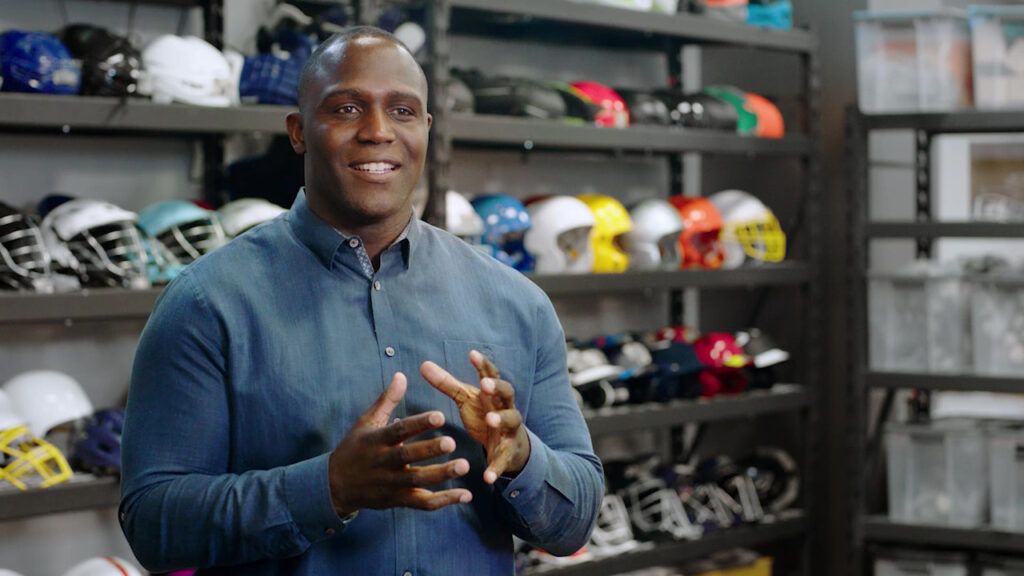
A Crash Cloud lacrosse helmet

This year, the Smithsonian National Museum of American History opened an exhibit honoring innovation in the sports world — and Springs, along with Windpact’s Crash Cloud technology, are in impressive company.

Springs is being recognized along with the inventors of Gatorade, the Jogbra sports bra and the high-speed photo finish camera, to name a few.

“There’s a challenge for a lot of guys who identified as athletes. Am I an innovator or an athlete?” he asked. “If you would have asked me, during my career, if I thought I (would be in the Smithsonian), I would have never been able to imagine that.

“Athletes are taught early on to idolize the Lebrons, the Tom Bradys, and you think that’s the biggest you can become.”

Given his NFL career, the bar is set high, but Springs may be on track to prove that theory wrong.

Read more on Athletes of Influence: Shaun Alexander develops NFL players into impact investors | Craig J. Lewis evolves as an entrepreneur and angel investor | more in the series here.

Video: Understanding the environmental impact of generative AI

Video: Understanding the environmental impact of generative AI

I recently joined Remy Blaire, host of FinTech TV’s “Market Movers,” to discuss the environmental impact of generative artificial intelligence and the new energy demand created by Gen AI. Watch our interview.

More Fintech TV: The increasing impact of natural disasters on real estate and insurance

Stress is the biggest danger white-collar workers face

Stress is the biggest danger white-collar workers face

We previously discussed the dangers that many workers face from extreme heat conditions, typically farming and construction industry employees, who often work outdoors without adequate breaks or access to fresh water.

Let’s not forget about white-collar workers, who appear to have cushy jobs in air-conditioned offices, but who may also be exposed to unhealthy environments. The extraordinarily long hours, demanding managers and tight deadlines have pushed some white-collar workers to the edge and, in some cases, have overworked them to death.

In May, 2024, a Bank of America investment banker and former Green Beret, 35-year old Leo Lukenas III, died after putting in 100 hours a week for a month while working on a $2 billion acquisition. He died when “a blood clot formed in a coronary artery.”

Twelve-hour days, 6 days a week, are the norm, say many interns, whose entry-level salaries may reach as high as $200,000 a year. Even 100 hours (or more) per week is possible for those working in high-stress jobs such as investment banking.

Many young employees don’t complain to their managers for fear of looking “weak.” One associate, according to the Wall Street Journal, left Bank of America when he was routinely asked to work 95-hour weeks. The WSJ, who spoke to dozens of bank employees, claimed that some upper managers told junior bankers to “ignore policies that limit working hours.”

These policies were installed years ago after a Bank of America intern in London, Moritz Erhardt, died in 2013 after having an epileptic seizure after working a series of grueling all-nighters. The new rules limited banker hours and gave bankers a “protected Saturday policy.”

Health problems from stress

For many young, ambitious employees, the long hours are worth the opportunity to make big bucks, while showing their managers they are willing to do almost anything to prove their loyalty and work ethic.

Not surprisingly, the excessively long hours and competitive workplace culture has taken a toll on the health of many workers, and not only investment bankers.

Some white-collar workers are sickened by unhealthy work environments such as mold, faulty or noisy air conditioners, and unsafe indoor air. Sometimes, these environmental hazards go undetected for years.

High levels of work-related stress

Stress has been another problem for many white-collar workers, who are often under extreme pressure to meet tight deadlines.

Some workers attempt to hide work-related stress symptoms such as extreme anxiety or burnout. Robert Sapolsky, in an article published by The American Institute of Stress, says: “The body is not designed to handle constant, unrelenting stress. Over time, the wear and tear can lead to severe health consequences.”

Stress is the biggest danger white-collar workers face

According to the American Institute of Stress: “Prolonged exposure to stress can lead to serious health problems including heart disease, hypertension and diabetes.”

A number of research studies have confirmed that long working hours and heavy workloads have led to physical problems such as heart attacks and strokes, weight gain, insomnia, as well as increased stress levels. Workplace stress not only keeps workers at home but makes them less productive at work.

Companies noted for providing first-class mental health support

Several independent sources have mentioned companies that provide first class mental health support to their employees. For example, Upkeep identified companies that have programs in place meant to improve the mental health of their employees.

These companies provided stress management and assistance programs (Johnson & Johnson JNJ ), wellness programs (Unilever UL )), suicide prevention campaigns (Union Pacific UNP ), physical and mental health services (Barry Wehmiller and New Brunswick Power), and a comprehensive mental health program (American Airlines AAL .

Also, Forbes magazine publishes an annual list of the best 100 companies to work for. The list is based on a survey of employees, which asks them a wide range of questions, including if they feel respected, if they receive support for their well-being, and if the company treats them fairly.

This year’s top 10:

  1. Hilton Worldwide Holdings HLT
  2. Cisco Systems CSCO
  3. Nvidia NVDA
  4. American Express AXP
  5. Synchrony SYF
  6. Wegmans Food Markets
  7. Accenture ACN
  8. Marriott International MAR
  9. Cadence CDNS
  10. Comcast CMCSA

What can employers do to reduce worker stress?

There are a number of steps that employers can take to reduce worker stress.

Employers can follow the lead of the companies mentioned above by creating mental and physical health programs. According to the World Health Organization, depression is the biggest worldwide problem for workers, costing businesses nearly $500 billion in “lost productivity.”

Companies can also encourage employees to lose weight by helping them switch from a fast-food diet to a nutritious one. Employers may help workers find ways to quit smoking, provide healthy on-site meals and snacks, and allow unrestricted access to water coolers.

One idea for employers is to routinely give out anonymous stress surveys with an opportunity for employees to provide feedback. Occupational Safety and Health Administration (OSHA) has a survey on their website with sample questions.

Although not always possible, it helps when employees are given more freedom depending on the type of work they do. If this is not feasible, employers may give some workers a variety of jobs rather than forcing them to do the same job every day. Rotating jobs helps reduce burnout.

To avoid emotional and physical work-related problems, employees should avoid working more than 80 to 100 hours a week. A 120-hour work week is not only unrealistic, but dangerous for workers. The human resources department probably has rules that prevent employees from working that many hours, but some managers ask their employees to hide the true number of hours worked.

It’s helpful when new, and typically younger workers, are given adequate training and an ongoing training program. Training programs help reduce stress in workers, especially for inexperienced or new hires.

Comfortable chairs and desks with neck and back rests or support pillows help show office workers that the company cares about their physical and emotional well-being. This may also help relieve repetitive strain injuries, i.e., damage to muscles and nerves resulting from constantly and repeatedly using the same motion.

Conclusion

White-collar workers who are asked to work extraordinarily long hours with unrealistic deadlines risk physical and psychological injuries, including anxiety and stress. It is up to employers, with help from the government, to make sure their employees are not asked by rogue managers to put their health and lives in danger just so they can help achieve a company’s financial goals.

Read more: Protecting workers from the heat: Juley Fulcher of Public Citizen on OSHA’s new rule

Protecting honey bees through organic farming and flower strips

Protecting honey bees through organic farming and flower strips

Honey bees are more likely to thrive when their habitats include organically farmed land and flower strips , new research from Germany shows.

A team from Martin Luther University Halle-Wittenberg and the University of Göttingen found that honey bee colonies in the vicinity of such land uses grew stronger and were generally healthier than honey bees that did not have those benefits. The researchers said that was most likely because the bees have a diverse and continuous food supply and were less exposed to pesticides in those areas.

“The way that farmers cultivate their land has a major impact on nature. Intensively farmed fields, pesticides and monocultures pose a threat to many animal and plant species. This is particularly true for pollinators, which include honey bees,” says Prof. Robert Paxton, a bee researcher at Martin Luther University.

The researchers looked at three actions that could counter the threat: increased use of organic farming, the planting of flower strips among the crops and creating perennial semi-natural habitats near farmed land. According to the German Environment Agency, around half of Germany’s land is used for agriculture.

“In theory, these measures all make sense. However, we know little about how each of these affect insects, especially honey bees,” Paxton said in a post on the university’s website.

So the team from Halle and Göttingen carried out a study at 16 locations in Lower Saxony, Germany. Each of these locations differed in their proportion of organic fields, flower strips and perennial semi-natural habitats.

The researchers placed a total of 32 honey bee colonies at the sites and observed them for about a year. They analyzed, for example, colony growth and parasite infestation. Special attention was paid to the varroa mite—a particularly dangerous pest of honey bees which can transmit fatal viruses. The data gathered about the bee colonies was then compared.

“Organic farming had the greatest impact—the larger the proportion of these areas, the lower the parasite infestation of a colony. This improved colony growth,” explained lead author Patrycja Pluta from Martin Luther University.

Protecting honey bees through organic farming and flower strips
Illinois Dept. of Natural Resources photo

She said one reason could be that organic farming uses fewer pesticides and, instead, other plant protection measures. Flower strips were also advantageous to honey bees: the number of Varroa mites was lower in areas with a lot of flower strips.

“This could be due to the fact that a diverse and rich food supply strengthens the honey bees’ immune system,” Pluta said.

Perennial semi-natural habitats, on the other hand, tended not to help the honey bees. Larger areas generally meant a greater infestation of varroa mites. And, unlike flower strips, the areas are not designed to provide an abundant supply of food for honey bees and other pollinators.

“Perennial semi-natural landscapes are an important tool for promoting biodiversity and they serve as a habitat for many animals. Honey bees, that are managed by humans, are the exception,” Paxton said.

The honey bee study was published in the Journal of Applied Ecology. The researchers hope the findings of the study help to improve agricultural landscape management for bees and other pollinators.

Read more: Regenerative agriculture: Investing in food production in a more sustainable way

These 5 companies have paid the biggest fines for ethics violations

These 5 companies have paid the biggest fines for ethics violations, YourStake says

This is one in a series of articles that will incorporate data from YourStake, a technology platform designed to help financial advisors and investors align their portfolios with personal values, focusing on ESG criteria.

The market for corporate attorneys is booming — and bad behavior in business certainly isn’t hurting.

Fighting legal challenges, law advocacy and lawsuit defense have become increasingly common for global corporations. According to a report from the Association of Corporate Counsel, companies with market capitalizations of more than $20 billion are estimated to employ 145 legal workers at a cost of $80 million each year.

Why so much spending on legal defense? Because that amount pales in comparison to the actual fines levied for ethics violations by these companies, which are estimated to have paid more than $1 trillion in penalties since 2000.

Let’s take a look at the top five companies that paid the most in fines since 2017, which together have accounted for $20.4 billion in penalties. That’s more than double the yearly budget for the U.S. Attorney’s Office.

5. Bank of America ($2.31 billion)

Since 2017, Bank of America BAC has spent cash 32 times to settle legal issues, whether through judgments against the multinational investment bank or by reaching settlements with disgruntled parties.

More than half of its $2.31 billion in penalties came from one alleged incident — a 2018 lawsuit claiming it imposed excessive overdraft fees on checking account customers. The total settlement of the consumer protection violation was $1.27 billion, though most of that penalty was calculated by factoring in the lost revenue resulting from its change in practices.

Bank of America did, however, shell out $66 million to 5.9 million customers who had been adversely affected by its practice of charging an “extended overdrawn balance charge” in addition to $35 overdraft fees.

While that lawsuit had one of the most significant financial impacts on the corporation in recent years, Bank of America has continued to receive sanctions for similar practices, including the following instances:

  • 2017 — $22 million settlement paid on allegations the bank improperly applied overdraft fees on customers using debit cards for Uber rides
  • 2020 — $5 million settlement paid to settle litigation claiming Bank of America charged customers improper overdraft fees on transactions with gig economy service providers
  • 2022 — $75 million settlement paid, and the bank agreed to make changes in its business practices, after being accused of improperly charging overdraft fees to customers whose accounts were empty
  • 2023 — $60 million fine paid to the Office of the Comptroller of the Currency for assessing multiple overdraft and insufficient fund fees against customers for a single transaction.

4. Boeing ($2.6 billion)

The financial impact the 737 Max has had on Boeing BA pales in comparison to the human impact the failed airliner has caused since first taking to the skies in 2016. A total of 346 people died in two fatal incidents that occurred in October 2018 and March 2019. The incidents led to the 18-month grounding of all 387 aircraft delivered to commercial customers.

In 2021, Boeing entered into an agreement with the Department of Justice to resolve a criminal charge related to a conspiracy to defraud the Federal Aviation Administration’s Aircraft Evaluation Group concerning evaluations of the plane. The agreement included a $243 million criminal monetary penalty, compensation payments to 737 Max airline customers of $1.77 billion and the establishment of a $500 million crash-victim beneficiaries fund for the families of the victims of Lion Air Flight 610 and Ethiopian Airlines Flight 302.

The fines, however, were a drop in the bucket of the total financial impact the 737 Max had on Boeing. In addition to the $2.5 billion in penalties, Boeing is estimated to have spent an additional $17.5 billion in compensation and legal fees. Additionally, the 1,200 canceled orders resulting from the two fatal incidents account for more than $60 billion in indirect losses.

3. Goldman Sachs ($3.21 billion)

The second-largest investment bank in the world comes in third place on this list after it is reported to have suffered $3.21 billion in penalties since 2017.

In 2020, Goldman agreed to pay more than $2.9 billion to criminal and civil authorities in the United States as part of a settlement agreement.

The allegations were levied after it was discovered that Goldman GS was participating in a scheme to pay more than $1 billion in bribes to Malaysian and Abu Dhabi officials to obtain lucrative business. The bribes allegedly resulted in Goldman underwriting about $6.5 billion in three Malaysian bond deals, earning the bank hundreds of millions in fees.

Goldman Sachs denies wrongdoing in the case, instead claiming that members of the previous Malaysian government were not honest about how the proceeds of the bond sale would be used.

Officials said the bond deal earned Goldman over $500 million in fees, leading to large bonuses for its executives.

2. Visa ($4.1 billion)

Visa has had a nearly clean slate regarding legal battles over the past seven years, but unfortunately for the global payment processing network, its one instance of alleged bad behavior proved extremely costly.

In 2019, Visa and its main competitor, Mastercard MA , agreed to pay a combined $6.2 billion to settle litigation alleging collusion to raise swipe fees paid by merchants. The settlement received final court approval in 2019, but it wasn’t until a federal appeals court in Manhattan upheld the accord in 2023 that the agreement became official.

This year, Visa announced a proposed settlement in March that sought to end a separate legal battle on swipe fees that began in 2005. In June, a U.S. judge rejected Visa and Mastercard’s proposed $30 billion settlement, which would have resulted in lower swipe fees and decreased revenue for both companies.

1. Wells Fargo ($8.21 billion)

With at least twice the amount of fines and settlement payments doled out than any other company on this list, Wells Fargo WFC is the king of ethical miscues, leading to costly payouts to customers and financial regulators. Of the $8.21 billion in fines Wells Fargo has paid since 2017, two incidents account for $6.7 billion.

In 2020, Wells Fargo signed a deferred prosecution agreement and agreed to pay $3 billion to resolve potential criminal and civil liability stemming from a practice between 2002 and 2016 of pressuring employees to meet unrealistic sales goals. That move led thousands of employees to provide millions of accounts or products to customers under false pretenses or without consent, prosecutors alleged.

Two years later, the financial-services company agreed to pay $2 billion in redress to consumers and a $1.7 billion civil penalty for legal violations across several of its largest product lines. The Consumer Financial Protection Bureau claimed Wells Fargo illegally assessed fees and interest charges on auto and mortgage loans that directly led to the repossession and foreclosure of customers’ property.

The bank was also accused of charging consumers unlawful surprise overdraft fees to checking and saving accounts. About 16 million people were believed to be affected.

YourStake embraces data transparency on its company screeners to combat “greenwashing” and uses more than 150 databases to provide accurate information to impact investors. For the corporate ethics violation study YouStake relied on Violation Tracker, produced by the Corporate Research Project of Good Jobs First, a wide-ranging database on misconduct by large and small corporations throughout the United States.

Read more: These 5 S&P 500 companies are the best at promoting diversity, YourStake rankings show

Video: The climate management and carbon accounting regulatory environment

Video: The climate management and carbon accounting regulatory environment

I spoke with Peter Bartolino, chief legal officer at Persefoni, at the recent GreenFin 24 conference about climate management and carbon accounting, including the current regulatory environment across the country and around the world. Watch our interview.

More videos from GreenFin 24: Nature-based solutions for meeting net-zero goalsNew roles evolving in corporate decarbonization efforts | The role of insurance in the carbon markets | The 3-D themes of decarbonization, deglobalization and demographics

Interest rates and stocks: Mark your calendar for the Sept. 17 Fed meeting

Who turned the stock market upside down?

The U.S. Federal Reserve has hinted it may start cutting interest rates in September. We will find out more Friday when Fed Chairman Jerome Powell speaks at the central bank’s retreat in Jackson Hole, Wyoming.

The market is telling us it’s a done deal, with odds hitting 100% on CME FedWatch, a widely used tool that predicts changes in interest rates. The only open question is whether the cut will be a quarter of a percentage point or a half percentage point.

And as market strategist Charlie Bilello pointed out, the Fed has done exactly what the market expected it to in every meeting since 2009.

Warren Buffett compares interest rates to gravity, saying: “The value of every business—the value of a farm, house or any other asset—is 100% sensitive to interest rates.”

Rates up, stocks down. Rates down, stocks up. That’s overly simplistic, but directionally right.

There are two important takeaways as we approach a Fed easing cycle:

1. Interest rates and stock rotation

Spiking interest rates are a big reason large stocks rushed their smaller peers over the past few years.

Large companies borrowed billions of dollars during 2020/2021 at record-low rates. Over 90% of this debt is long-term fixed. Rising rates barely hit these companies. Small stocks, like those in the Russell 2000, aren’t so lucky. Roughly half their debt is “floating” rate.

These companies are paying two to three times more interest than they were a few years ago, which cannibalized profits. Now, with rate cuts on the horizon, investors are piling into smaller stocks.

2. Rate cuts typically boost stocks

Following each of the Fed’s first rate cuts of a cycle dating back to 1970, the S&P 500 was higher 13 out of 18 times, carving out a 13% gain, on average. The only times stocks tanked were during the early ’70s downturn, the dot-com bust and the 2008 financial crisis.

Our research shows the real dividing line is whether the U.S. economy dips into a recession or not. Rate cuts + no recession = higher stock prices.

My No. 1 way to ‘read’ the economy

Hedge funds pay for satellite images to count cars in Walmart WMT parking lots. Then they use these snaps to predict Walmart’s earnings before it reports.

There’s another way to get “the jump” on what’s happening in the economy that won’t cost you $100,000 a year. Listen to earnings calls.

Hearing what mega corporations like Apple AAPL or Amazon AMZN say about the U.S. consumer gives you a far better understanding of the situation than any government report ever will. We’re at the end of the second-quarter earnings season. So far, the number of companies beating revenue expectations is the lowest since 2019.

And the slowdown is mostly coming from sectors hit by higher borrowing costs. People are buying fewer cars and homes. Brunswick BC , America’s largest boat maker, said its customers are basically saying, “We’ll buy a new Bayliner when rates drop.” Funny how boat makers are now Fed watchers.

Meanwhile, credit-card firms and banks are saying on earnings calls that credit card delinquencies are rising to multi-year highs. If you’re looking for signs of a slowdown, listen to earnings calls.

Today’s dose of optimism

I live by this Confucius quote: “A healthy man wants a thousand things; a sick man only wants one.”

When you’re healthy, you have many desires and goals. But when you’re sick, all those other wants fade away. You only care about one thing: getting healthy again.

The best way to live a long, healthy life? Exercise.

Research from Peter Attia, a physician and longevity expert, shows exercise is the behavior most strongly associated with extending your life. In short, every hour you spend exercising is likely to give you six to eight hours of additional healthy life. That’s literally the deal of a lifetime!

Run … row … bike … swim … lift weights … box … train in jiu jitsu … practice gymnastics. Do some form of exercise until you’re “out of breath” at least every other day.

Don’t slack on your fitness. Future you will thank you.

Read more: If I could buy only 1 big tech stock, this would be it

Women of Impact: ‘Bad Bitch Empress’ Lisa Carmen Wang on building successful businesses for women

Women of Impact: 'Bad Bitch Emperor' Lisa Carmen Wang on Building Cash Flow Positive Businesses for Women

By Paula DeLaurentis and Sophia Forlenza

You’d think that the woman who created the aptly named and rightfully deserved “Bad Bitch Empire” would display a fearless nature and unapologetic ambition. And Lisa Carmen Wang does.

But Wang was not necessarily born a force to be reckoned with. Coming from an immigrant background and an abusive past relationship, there is no shortage of  guilt — or “brainwashing,” as Wang puts it — in her life that she’s learned to overcome. And she is no stranger to the effects of internalized misogyny in the investment world.

“The moment you strip away [the brainwashing] is the moment that you’re going to bloom,” says Wang, a four-time U.S. national champion and Hall of Fame gymnast.

Wang discusses how these core parts of her experience and identity influence the way that she and other women work as entrepreneurs, forcing them to have to “tiptoe around … the fear of being a greedy, selfish woman who actually wants money.” 

She highlights how this fear is multifaceted: “the fear of being called a bitch when you’re assertive and direct” is yet another insidious hindrance women face not just in the investment industry, but also as they navigate their daily lives.

In overcoming those obstacles she now feels she has created an entrepreneurial “reign” for herself and “rules” as a business coach dedicated to empowering women to reach their greatest potential as business owners so that they can “collectively invest together in the next billion-dollar female-led business.” 

That’s why she launched the BBE Venture Fund to empower women to invest collectively into high-impact female-led startups

Wang explains that women tend to fall victim to the often false narrative of the American dream: that everyone should strive to build a billion-dollar business by seeking venture capital funding. In this ambitious pursuit, many women’s efforts are ultimately fruitless because they end up unable to fundraise when they build “highly unprofitable businesses.”

“What you get is a burnt out and broke entrepreneur who’s jaded and can’t raise money,” Wang asserts. 

Women of Impact: 'Bad Bitch Emperor' Lisa Carmen Wang on building successful businesses for women

Wang has discovered that the key to women’s success actually lies in “building a cash-flow-positive business that doesn’t require a loan or any sort of debt to survive,” instead of pursuing high growth and funding, as is typical of beginner female entrepreneurs. 

This is precisely why Wang has developed a group coaching program for women entrepreneurs to build their own empires, which she believes is “the core of what [she does] really well.” Wang describes her “feminine business strategy” that wholly changes the way women conduct their businesses: monetizing their own passions, expertise, and skills by leveraging the power of social media platforms.

Wang explains that she often works with people who express that they feel like something in their life is missing. Her program targets that absence and uses it to create a positive cycle for women everywhere — when women are able to capitalize off of the very things that fulfill them, they are, in turn, inspired to invest in other women-led businesses.

Read more on Women of Impact: Veris Wealth Partner’s Stephanie Cohn Rupp and her 100% commitment to ESG | Kelly Ann Winget on her alternative investment fund and gender bias | more articles in this series here