


Investing in pizza, then people: How Sal Lupoli reinvented a dying town
Lawrence, Massachusetts, was hanging on by a thread before Sal Lupoli set his sights on the city.
Just a short trip north of Boston, Lawrence didn’t have much going for it after the 1930s when the textile industry folded and left dozens of large-scale mills to fall into disrepair and blight.
The buildings, typically five to seven stories with 15-foot-high ceilings and large windows, were more or less skyscrapers laid out horizontally. Without massive industry to occupy them, they had no practical use for the people of Lawrence.
At least not until Lupoli found them in the early 2000s.
An Italian upbringing, business sense and, of course, pizza
Lupoli grew up in East Boston, a second-generation immigrant and one of six sons. He grew up poor, and his mother, he said, had to work to keep the family afloat.
His father taught him from a young age to work for the things he wanted — a lesson Lupoli still embraces today.
“One of the lessons I was taught is to never push your face against the glass and want something so bad. Don’t ask for it — just move on,” he said.
After graduating from Northeastern University in 1988, thanks to a full athletic scholarship for football, Lupoli expanded on a business plan in school and used the experience gained from working in a small pizza business in Boston’s North End to open Sal’s Pizza in 1990.
His father took out a third mortgage and Lupoli sold his first car to fund a 780-square-foot storefront in Salem, New Hampshire, that he opened with his brother, Nick.
By 10 years in business, Lupoli had built a very comfortable life. At that point operating about 15 pizza stores, Lupoli had pulled himself out of poverty and also helped improve the lives of his parents and brothers.
“When you’re given an opportunity to make a difference in people’s lives, you get addicted to it. And I did,” he said.
Risking it all on the most unlikely of bets: Lawrence
By the early 2000s, Lawrence had experienced about 70 years of poverty since the departure of the textile industry. Dubbed one of the 40 poorest cities in the country during the Clinton administration, the city of about 90,000 people didn’t have much hope.

As residents struggled to make ends meet, Lawrence became a haven for insurance fraud. About 400 homes burned down each year — more than one per day, Lupoli said.
The city still has a large immigrant population, about 80% Latino. Lupoli recognized the similarities between his own upbringing and the plight of Lawrence residents and became emotionally invested.
“At 35 years old, I mortgaged everything,” he said.
Lupoli took loans against his pizza stores, his own home and even his mother’s home to invest the money into Lawrence with a 20-year plan.
“I bet it all on this blighted city with homeless people living in the buildings and buildings with no roof,” he said.
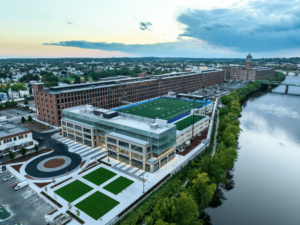
Lupoli estimates he had about 18 months of mortgage payments to fund the Riverwalk — a former textile mill that he envisioned turning into a work/live/play development along the Merrimack River.
“I borrowed enough for 18 months, but I had to get to 30% occupancy,” he said. In nine months, he achieved 70%.
When Lupoli talked with a Lawrence City Council member about zoning the property from industrial to mixed-use commercial, retail, and residential, the municipality quickly agreed.
“I told them I have a 20-year vision,” Lupoli said. “He started laughing.”
Supporting revitalization after revenue generation takes sacrifice
Despite the success in attracting tenants to Lupoli’s newly purchased Riverwalk, the real estate developer admits that Lawrence’s turnaround could not have happened without boosting the local economy.
“It was never about housing. It was always about the jobs,” he said.
Lupoli understood he couldn’t attract major business to Lawrence and that revitalization would have to be supported by small, family-owned companies that saw potential in the community just as he did.
“How do you incentivize IBM to come to a city like that? The answer is: They won’t,” he said.
Lupoli did it himself — and he started with what he knew best. Restaurants.
“I don’t want to give you the fish, I want to teach you to fish,” he said. “We took our own money and opened the Revolving Test Kitchen. I built something that would make you think you’re in the trendiest part of New York City or Boston — and I put it in the worst section of Lawrence.”
The kitchen hosted local food entrepreneurs who aspired to own restaurants. They kept the profits. They had access to Lupoli’s team of marketing and accounting experts.
The catch? When they made enough money, they had to promise to open their own restaurant and allow another candidate to take the reins.
“Having the American dream itself … that’s a low barrier of entry,” he said. “Today, it’s hard because of the expenses — and then when you get the money together — it’s hard to stay open.”
Aside from restaurants, Lupoli remembered his childhood and recognized the need for affordable childcare in Lawrence to support the new business development.
“I found the largest daycare provider in the entire Merrimack Valley, and on bended knee, I begged her to put one of her satellite stores in my building. I told her I’ll give the lowest rent possible if you give everyone here a rebate on childcare,” Lupoli said.
“She said, ‘Sal, no one is here. And I said, ‘There will be one day.’”
With Lawrence on the upswing, what’s next?
Without any outside investment, Lupoli believes Lawrence’s story should be used as a model for the entire country. His efforts to expand on the momentum he created continue today.
Two years ago, Lupoli and then-Massachusetts Gov. Charlie Baker, cut the ribbon on a turf football field Lupoli had built on top of a new parking garage at Riverwalk, which continues to expand. The location now has about 600 apartments, dozens of small businesses and several satellite campuses of local colleges.
In 2020, Lupoli partnered with North Essex Community College in Haverhill to open the Lupoli Family Institute of Culinary Arts, which offers classes tailored to nontraditional students.
Lupoli’s dedication to improving the Merrimack Valley and willingness to invest short-term profits into people for long-term gain has led to the resurgence of what was once the poorest city in Massachusetts. He said he’s considering development in Lowell, Mass., which he said is referred to as a “gateway city.”
“That’s just a nice term for a poor city,” he said. “What I want to do is go to wherever there are entrepreneurs that want to impact their community. A rising tide lifts all boats.”
Read more: The risks and rewards of putting your values to the test

Read Next


