


Anti-ESG shareholder proposals jump in 2024, but find almost no support
Shareholder proposals designed to curtail corporate environmental, diversity or ESG disclosures have flooded annual meetings in 2024, but support for these measures has dwindled to less than 2% of stockholder voters, a memorandum from the Sustainable Investments Institute shows.
In a post on the Harvard Law School Forum on Corporate Governance Heidi Welsh, executive director at the institute, said 81 of more than 100 anti-ESG proposals have been voted on as of June 30 this year, gaining support of just 1.9% of shareholders. That support is less than half of what such proposals earned just three years ago, the data showed.
While support for positive ESG proposals has also dwindled, it averages about 19% of all voters, 10 times the negative sentiment.
“The anti-ESG proposals continued to focus largely on disrupting the current business world consensus that diversity, equity and inclusion improves companies and benefits investors,” Welsh wrote. “But they also continued to suggest that corporate political involvement favors liberals and took aim at efforts to mitigate climate change.”
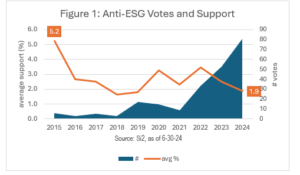
About half of these proposals have expressed opposition in one way or another to current approaches to diversity, equity and inclusion. This evergreen idea from the right has always dominated anti-ESG proposals (about half in each year except in 2016 and 2021, and 42 percent in 2024), the institute said.
“These resolution also now explicitly posit that straight white men with right-wing political and/or religious viewpoints face disadvantages in corporate America, sometimes because they own guns or support gun owners, or because they oppose LGBTQ rights,” Welsh wrote.
The second most common proposition is that companies in their interactions with the political world favor politicians and causes that have “woke ideas,” which allegedly hurt corporate profitability. (Those proposals averaged 30 percent of submissions over the decade and 25 percent this year.) The claim is that companies are abrogating their fiduciary responsibility to investors.
Third, and in sharp contrast to shareholder proposals overall, anti-ESG proponents have been relatively uninterested in environmental issues and climate change (11 percent over 10 years, 15 percent this year).
“The key idea expressed in these is that efforts to curb greenhouse gas emissions are too expensive, likely futile and based on questionable science. This view flies in the face of widespread scientific and investor consensus that climate change poses the most disruptive set of risks and opportunities we have ever faced,” Welsh wrote.
The remaining proposals this year ask about health benefits and those about corporate ties to the Chinese Communist Party. Most notable this year were particularly detailed objections to corporate benefits for transgender people but a strong animus against LGBTQ people cropped up elsewhere, too, regarding corporate and employee resource groups’ support for advocacy groups.
Read more: ESG investing has been under attack, but advisors and brokers have largely quashed the backlash

Read Next


