


95% of U.S. childcare workers are women, and they are nearly the worst paid in the country
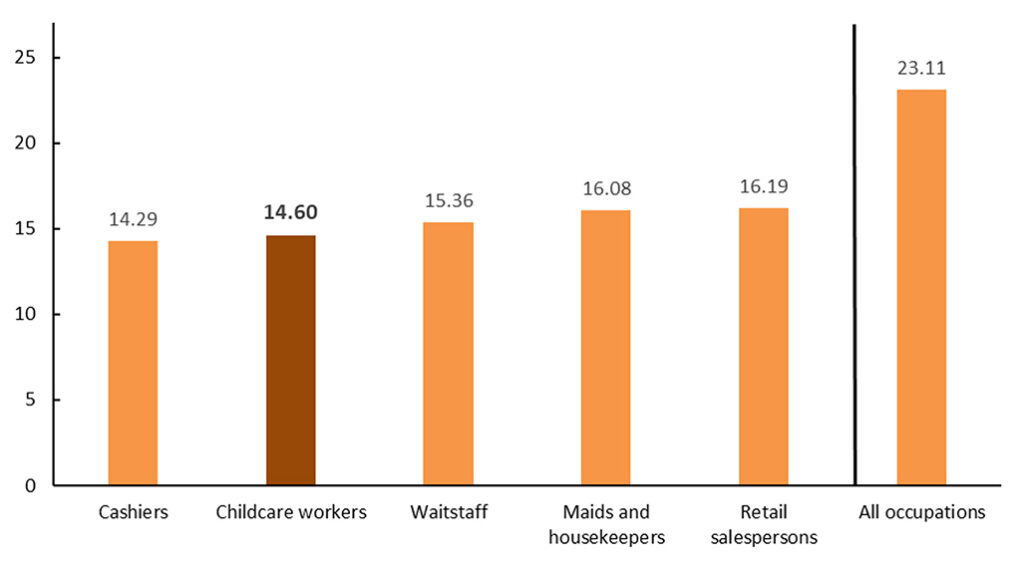
The median wage paid to childcare workers — 95% of whom are women — is in the bottom 5% of all occupations and has grown less quickly than wages paid to workers in other service sector jobs in the post-pandemic period, a new study from the Federal Reserve Bank of Chicago has found.

The study, by Kristin Butcher, Elizabeth Kepner, Kelli Marquardt and Brianna Smith is part of the Chicago Fed’s Spotlight on Childcare, a targeted effort to understand how access to childcare can affect employment and the economy.
“Understanding the labor market for childcare workers is critical to understanding the challenges that families can face while attempting to access reliable, affordable, and convenient childcare,” the authors said.
While there are fewer young children today than there were before the pandemic, women with young children are more likely to be participating in the labor force and are working more hours, conditional on participating, than prior to the pandemic, the study found, suggesting there is now a greater demand for childcare, especially among women with young children.
“While those opposing forces play out against a backdrop of shifting work-from-home arrangements, employers and families continue to report access to affordable, high-quality childcare as a major barrier to employment,” the authors said.
Other highlights from the study:
- Childcare workers are twice as likely to be women, about 15% more likely to be Hispanic or non-Hispanic Black, and 40% less likely to have a bachelor’s degree or higher education than the overall employed population.
- The number of childcare workers, broadly defined according to reported occupations, remained 9% below its pre-pandemic level as of year-end 2023.
- The majority of childcare workers are employed in either the child day care services industry or private households. Employment within the child day care services industry is concentrated among small establishments (those with fewer than 20 employees or with 20 to 49 employees).
- Childcare workers leave the occupation relatively frequently, often exiting the labor force entirely. When these workers leave the childcare sector, it is often for jobs in another low-wage service sector, such as cashier, retail salesperson, waitstaff, or housekeeper; by the end of 2023, most of these occupations had higher wages than a childcare worker.
Read more: Women have made progress as scientific researchers, but parity is a long way off


Read Next


