More than 100 University of Chicago alumni are demanding the school’s endowment divest itself of fossil-fuel interests and say they will refuse to donate to the university until all fossil-fuel allocations are eliminated.
The alumni movement is spearheaded by UChicago for Climate Action, a group founded in 2023 by UC alumni who want the university to advance a livable future, and parallels an on-campus student-led effort, UChicago Divest, which has collected over 2,500 signatures from the university community.
A letter sent to the university by the alumni notes that UC is behind other leading universities in fossil-fuel divestment. If UC agrees with this alumni call, the university would join a number of leading institutions like Oxford and Cambridge which are working to divest from fossil fuels, the letter points out.
“If the University of Chicago wants to truly be a peer of Ivy League institutions, the board should approve this change and join the majority of Ivys like Brown, Cornell, Columbia, Dartmouth, Harvard, and Princeton in working to divest from or substantially reduce investment in fossil fuels,” said Katharine Bierce, one of the co-founders of UChicago for Climate Action.
The group argues the university’s investments in fossil fuel are at odds with its sustainability plan, established in 2022. While universities like Notre Dame, Ball State and Princeton have committed to a net zero campus using solutions like electric heat pumps, thermal storage and geo-exchange technology, the University of Chicago still plans to rely on fossil fuels on campus via gas-fired central steam plant central heating, the group said in a press release.
“While the University was built from John Rockefeller’s oil money, it can choose – like many Rockefeller descendants today – not to use its wealth and prestige to prop up an industry that threatens life on this planet,” said Michael Hendrix, another of the co-founders of UChicago for Climate Action.
“Over a decade ago, my first campus job was calling alumni to fundraise. Many alumni today aren’t comfortable giving money to a university that invests its endowment in fossil-fuel companies.” he said.
In a statement to the Chicago Maroon, the official newspaper of the University of Chicago, the university said divestment was against its policy of abstaining from taking political or social stances, as articulated in its Kalven Report.
“Over more than a century, through a great deal of vigorous debate, the university has developed a consensus against taking social or political stances on issues outside its core mission,” a university spokesperson told the paper. “The university’s longstanding position is that doing this through investments or other means would only diminish the university’s distinctive contribution — providing a home for faculty and students to espouse and challenge the widest range of social practices and beliefs.”
The spokesperson said the UC investment team performs “due diligence to ensure that the funds in which it invests and their managers have no history of illegal behavior and have a strong track record of meeting the professional norms of their business.”
The university also said it would continue its efforts to reduce its greenhouse gas emissions.
“The university continues to focus on … the goal set in 2020 of a 50% reduction in emissions by 2030, by procuring renewable energy and implementing energy conservation projects,” the spokesperson told the Maroon.
The alumni demand is the latest development putting pressure on the University of Chicago. A student legal complaint in October of 2023 against the university filed with the Office of the Illinois Attorney General argues that the university’s fossil-fuel investments violate its responsibilities as a nonprofit institution.
Six months prior to the complaint filing, in April of 2023, over 200 people rallied on campus on the main quadrangle to call for divestment. Over 50 professors and 60 local and national organizations have joined the coalition of students to affirm that these investments contribute to the climate crisis and cause harm to UC’s students and community.
Nationally, nearly 100 educational institutions have committed to some form of fossil-fuel divestment, including Harvard, Yale, Princeton, Georgetown, Cornell, Syracuse, and the University of Michigan, according to the Global Fossil Fuel Divestment Commitments database.
The Sustainable Finance Podcast is a weekly program featuring conversations with sustainability thought leaders such as cleantech entrepreneurs, VC investors, CEOs, NGO executives, and creators of the ESG indices and analytics platforms.
Tee Ganbold is co-founder and CEO at Improvability AI, the generative AI improvement engine for sustainability, which is making sustainability cost effective for everyone. In my interview I ask Tee to walk us through how businesses can enhance their sustainability focus and increase profits through intuitive AI agents and applications that automate tasks and workflows to lower costs in the business model and supply chains.
Paul Ellis: Hello Tee and welcome to the Sustainable Finance Podcast. You’ve been at a summit in London, right? Please tell us about it.
Tee Ganbold: Yes. And thank you for having me. Last week I attended the Sustainable Markets Initiative gathering for CEOs. It was the Spring Summit and we gathered about 200 leaders, from the CEO of Bank of America to CEOs of funds to CEOs of private institutions that are the corporates that private equity firms own. So it was a mix and there were a few select technology companies which I’m delighted to have been representing. This initiative was launched by His Majesty King Charles III in 2020 as the ‘go-to’ global private sector organization on sustainable transition. This Spring Summit continued this work.
PE: You met a lot of new people, I’m sure, and made a lot of connections for your firm. That’s a wonderful opportunity. I want to start by making a statement but also turn it into a question for you. It’s my experience that good business decision makers use some method of decision intelligence to determine their needs in any given situation. How can generative AI support and improve that process for sustainability?
Tee Ganbold
TG: That’s such a great question, Paul, and I will allude to what I’ve been discussing with other CEOs in the last week. Let’s take the scenario of the Sustainable Markets Initiative. There are 200 CEOs operating billion-dollar businesses or investing in billion-dollar companies, and there is a level of understanding and consensus that sustainable markets need to happen. But to actually decide how is very challenging.
There’s a lot of debate. For example, in the real estate task force, there was debate over whether hydrogen or biofuel should be used. That debate requires the energy task force to tune in and provide perspective. This is a very human collaborative process, but the truth of the matter is we would have better decision making if we had this cross pollination of information from both task forces and the latest research being surfaced to decision makers using generative AI.
Imagine your experience of ChatGPT. You might ask ChatGPT for marketing help. You might write about marketing as a consumer, but in the business world or the finance world, it needs to be very accurate and it needs to come from sources that you can trust.
So, from a small community of researchers that you trust, you want that decision intelligence to surface and help you to make decisions. For example, in the real estate scenario you want the latest research on fuels so that you can go into a meeting and inform other stakeholders. At the moment, business leaders are going into meetings with incomplete information because we are making decisions on a few different data points. But we don’t have the latest research at hand from the energy sector, for example, because information is so disparate right now.
Knowledge is fragmented and the Internet is a bit like an ocean. We need generative AI that is based on collective intelligence from scientists, from researchers and the top leaders in industry who say this is verified, truthful information and let’s work off that. That’s when decision making is going to be much better for us all.
PE: I completely agree with you. And, of course, one of the big issues is that many leaders, as well as the people who are sourcing the data within their companies, are very hesitant to share that information across a broad swath of even their own sectors of the economy for competitive reasons. Was that part of the dialogue at the conference?
TG: That is an assumption, I believe, that is out there. But if you are working towards a collective goal, and everyone at the Sustainable Markets Initiative had a collective goal, they would like to invest in companies that are addressing sustainability, that are considering regulations and making sure it’s part of their business model, and are already making sure that they’re accounting for it. Within that collective, it is reasonable to suggest that they want to share the latest research.
If you’re not part of that collective, it is fair to say you don’t want to share information and that is totally fine. But this collective wants to progress, wants to invest in companies that are already accounting for such risk and that sort of collective will share information. We cannot expect everyone on the planet to do this. I don’t think that’s realistic.
It’s a little bit like OPEC. OPEC shares information based on OPEC’s interest. OPEC is very powerful because OPEC member states share information so that their interest in keeping oil prices high is served and any bit of intelligence that can serve OPEC’s interest will be shared.
In the Sustainable Markets Initiative’s case, any intelligence that can help further the goals of the Sustainable Markets Initiative can be shared and will be shared. And anything that is proprietary data is a different matter. For example, sharing customer data, sharing supplier data, if you think there’s something wrong with that supplier, you don’t want to share. But you might want intelligence on a supplier that is doing very positive things because it could save everyone in the collective time to do due diligence and do the repetitive work. And finally, competitive information should always be within the bounds of an organization.
But there is certain knowledge that a community needs, for example, to finance those who are lending to you, those who are insuring you, those who are making and creating regulations.
There is collective intelligence that needs to be shared and it is shared and that is the current reality. It is shared right now, but it needs to be shared better and it needs to be less fragmented. It needs to be clearer for everyone to utilize and that’s what generative AI is very, very useful for.
PE: Now I’m going to ask you to explain what a proactive AI agent does and how it supports decision intelligence.
TG: In the AI space, an AI agent is an emerging field. The reason is that in the past, AI has been used for predictive analytics on a few pieces of information about forecasting or better decision making with a few sets of data.
Where AI is going is that it is going to be much more proactive. I’ll give you an example. Meta
META
, formerly known as Facebook, has an AI agent connecting to their 1% responsible supplier goal. If you are at Meta and you’re the chief sustainability officer, you’ve created this goal for the different stakeholders, for your investors, for regulators, for your own teams. And it says we are going to have 1% responsible suppliers, so you’ve committed to that in your sustainability report.
What an AI agent does is connect your report that you’ve now communicated to the world to an internal database of procurement information and invoice information so that when teams are about to renew their contract three months in advance, they will be notified, and the AI agent would speak to them and say, you’re about to renew in three months. Have you considered these 10 suppliers for, let’s say, non-discretionary spending like pencils. We found 10 alternative suppliers you can interview. Can you have a look at these because in three months’ time you’re going to have to renew your contract with somebody because Meta needs pencils, because engineers like to draw, yeah, they do like to draw, they like pen and paper and pencils. These are responsible suppliers because they’ve recycled a particular source and here are 10.
Improvability AI via Facebook
So that’s what an AI agent is. It connects a very large, strategic goal set out in a report with a very specific set of data such as procurement information. Meta has probably got billions of suppliers around the world trying to sell to them. So again, a lot of data there and they’ve also got invoice data. They know when the contracts are up.
That’s what an AI agent does. It connects these dots, which really is the role of a sustainable procurement officer or someone in the procurement team having to make these decisions. But it could be much more intelligent. It really engages different teams who know nothing about sustainability, but they probably care because a lot of people in Silicon Valley care about where their pencils come from. So it does this amazing thing of allowing Meta to deliver on a wider goal, but also it allows the people within Meta to feel that the company is actually caring and being proactive.
PE: I think you’ve partially answered our next question, but I’ll start from the beginning of it anyway. When C-suite and board level leaders of a company take the initial step of deciding what sustainability data to measure, for example in this case, where do we get our pencils, the tracking is often done by data vendors that rarely produce industry competitive or AI sustainability outperformance. How does Improvability AI support the performance, the how and the why of measurement for sustainability data and for competitive outperformance results by the firm?
TG: So that question really leads me to what is happening in the market right now.
In the current market, for anyone watching out there, most large financial services or corporates have to make do with one large company that does supply chain due diligence. It is fantastic and has done a fantastic job for the last 10 years. It’s a French company that helps companies do supply chain due diligence and gives ratings. The issue with it and the business model is that it is so restrictive.
For example, you’re Meta and you ask all your suppliers to do supply chain due diligence. Currently, if your supplier employs under 25 people you have to pay $900. That’s a lot. And it, of course, scales and costs more with more people. So, what we’ve done to address that problem, to gather more information on responsible and sustainable suppliers, is to make it free—make this entire process free. And we’ve got very large companies saying we really want to make this free until verification.
Verification is very important. When companies give their data on what they’re actually doing, let’s say going back to pencils: I’m a pencil supplier and I am using X material. My people are treated well and we are following the rules. Verification of that data is when you provide evidence that you’re actually doing what you say you are.
So whether it’s certificates or evidence of a particular material or you’re paying your taxes, that is verification. But the initial part, it should be free for you to ask a company if they’re sustainable or not. It should be free until you want to double check. So that’s the problem right now.
Another problem we address is that a lot of companies have a lot of research and a lot of data within their own four walls. And a lot of the time it’s fantastic knowledge. There’s a presumption that we have to go on the internet for certain information.
But, if you’re a industry leader or if you’re a company, the types that we’re speaking with or the category we’re talking with is $100 million plus turnover. These are the companies that are being regulated in California or in Europe. These companies have done a lot of research on what is a sustainable supplier to them and what is not. All they need to do is to bring that data. And this is where generative AI is very helpful to resurface information within one’s own database.
Let’s say all your supplier data is in one place in a company. And I’ll give you a scenario, a university in America that is trying to attract the top Gen Z from around the world because that’s how they get their revenue and their ranking. They have signed a pledge to be part of the Coolfood initiative.
World Resources Institute photo
So C-O-O-L. It means providing their students with sustainable food. How do they do this and what is the process? They have to understand all their suppliers and what they’re doing. And they have to understand, let’s say tomato. We all like tomato in our sandwiches and our salads. So, they would need to understand all their suppliers of tomatoes and they would need to understand who is sustainable and who is not. That intelligence could be: at least they have an idea of who their suppliers are right now.
They could surface all that data of all their tomato suppliers, that’s number one. They need to do that. Number two, they might need to do due diligence on all their suppliers. So that’s when number one comes in, the sustainability due diligence process. But fundamentally, a lot of knowledge is already sitting within an organization’s database, and there are a lot of notes, there’s a lot of history already there.
People can already start automating report writing on the platform. That’s an area where we think companies really need help lowering their costs. You can go on the platform, you can start automating internal CEO memos, and we’re now going to start automating CSRD reports, which is a massive cost to organizations.
PE: Yes, the regulatory infrastructure starting in Europe because that’s where everything begins, it seems. So that’s a good example of a place to start. How can universities or companies get started on the path to making sustainability competitive and profitable with AI if they’re not already doing that?
TG: Our key goal is to help companies to become sustainable at an affordable and accessible cost, because if it is very costly, no one is going to become sustainable. And that’s how a company can focus on their profitability. Becoming sustainable should not be a huge cost center. What we’ve done is lower the access to entry to become a sustainable company. The pricing of the existing incumbents is ludicrous. I’ll compare it to Adobe. Before Canva came about, Adobe was so expensive you only had a few companies with nice design. I don’t know if you use Canva, Paul?
PE: I have, yes.
TG: Remember when it was only Adobe? It was like $7,500, so only a few companies could afford a designer who even knew how to use Adobe to design marketing materials. So only a few companies looked presentable. Everyone else had terrible marketing. This is where Canva came about, so that businesses could have good design. Canva has democratised access to good design.
What we’re doing is seeing the incumbents as Adobe. They are making it so expensive to become sustainable that the price needs to go down. So we are making it affordable and accessible for businesses to become sustainable.
It should be normal to be a sustainable business. It should be and it will with our mission: that businesses can focus on profit because that’s why they are there, to generate returns for the different stakeholders, whether it is their investors, their customers, their employees. We want them to go back to doing what they’re very good at by lowering the cost to becoming sustainable.
PE: That’s a fantastic mission! And we want to know where people can go to learn more about Improvability, AI and how they can get in touch with you.
TG: Thank you so much, Paul. Anyone can go to our website to learn more. They can also go to start querying information on public companies. Of course, you can only ask questions about public companies. But if they want to test it on their own companies, then they can access it.
I love for companies to get in touch about their pains, what they’re struggling with, how we can help them with lower cost, more accessible tools for them to become sustainable. Most organizations do want to get better because their customers are asking for it. If you need help, please get in touch. Our team will be delighted to help and really be the painkiller in this.
Changing consumer behavior has called upon corporations to put environmental, social and governance issues at the forefront of their business strategies. However, more importantly, internal diversity efforts have helped improve the process in which employees perceive a company’s ESG-focused strategies, furthering the conversation surrounding the importance of developing and implementing more progressive corporate social responsibility planning.
In an attempt to sway public opinion, and address internal concerns, organizations are building more robust CSR frameworks, leveraging ESG-focused initiatives, partially supported by external frameworks and industry standardization practices. To further bolster these efforts, and to address critical climate and environmental issues more effectively, organizations are now starting to look outside of their internal structures to deliver more purpose-driven solutions to environmental and social issues.
EarthDay.org image
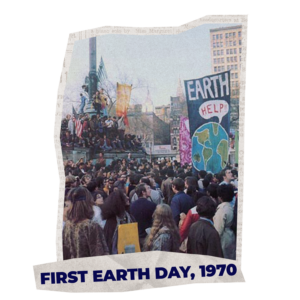
Since April 1970, Earth Day has become an internationally recognized event that is now celebrated by countries across the globe. Earth Day aims to address issues relating to the environment and how individual and organizational efforts can bolster environmental consciousness.
During the first several years, Earth Day drew support from more than 20 million American protestors aiming to raise awareness against the rapid deterioration of critical natural resources and the importance of establishing environmental laws, regulations and compliance practices.
Over the decades, Earth Day became more widely supported, having amassed more than 200 million supporters by the late 1990s and nearly a billion by 2000. Earth Day celebrates all the progress we’ve made since the year of its founding, however the conversation has now shifted to incorporate more progressive environmental policies that can help to combat climate change, mitigate impact driven by industrial activities and hold individual stakeholders accountable for their actions.
Today, the larger purpose of Earth Day is to continuously promote the justification for environmental laws, and build towards initiatives that can help protect endangered ecosystems and safeguard earth’s natural resources for future generations by helping to inspire more actionable efforts to build a cleaner and sustainable environment.
The link between Earth Day and corporate environmental strategies
Rapidly deteriorating environmental conditions, alongside the depletion of natural resources and the impact of industrial activities, have put pressure on corporations to develop and implement more progressive environmental strategies.
The focus here is not only on the internal justification of developing more sustainable solutions but rather on how organizational impact can drive change and better benefit communities.
For clarification, corporate social responsibility is centered on building corporate strategies that focus on the broader view of companies’ or organizations’ environmental responsibility and the actionable steps they take to make sustainable improvements and enhance self-regulation and environmental accountability.
On the other hand, environmental, social, and governance brings into question various metrics that can help stakeholders, including government entities, investors, employees and customers evaluate a company’s sustainability efforts. ESG places a strong emphasis on delivering reports using available data and is often administered by external bodies and regulators.
In this case, we’ll be focusing on how Earth Day can help inspire CSR activities more effectively, ensuring the company’s commitment to serving purposeful environmental strategies that can benefit employees, investors, customers, and most importantly, the environment and surrounding communities.
Corporate social responsibility in practice
For organizational leaders, CSR in practice can mean the following:
Corporate strategies are developed in accordance with efforts to benefit communities and the societies they exist within.
CSR deliverables are goal-oriented and can vary across organizations, departments and teams; however, these activities support the broader view and align with the company’s commitments and overall mission.
Incorporation of accountability and self-regulation are critical elements within internal communication processes.
Delivery of performance metrics is shared, communicated and discussed between management, investors and employees.
Implementation of CSR initiatives serves as a benchmark for mitigating environmental and social harm.
CSR is used in part as an indicator of company culture that aims to promote satisfactory employee conditions and improve overall performance.
As more organizations begin to recognize the importance of incorporating CSR activities into their corporate practices, they are also finding the efforts lead to several beneficial advantages against market competitors:
Improves employee retention and engagement: The importance of having a palatable CSR mission may influence a company’s ability to hire, retain and onboard employees. In one study, researchers found that corporate social responsibility and internal and external CSR activities can improve employee satisfaction.
Improves cross-functional employee relationships:Similarly, having a strong understanding of CSR mission values may help develop more cross-functional employee relationships. This is seen in the same study, whereby researchers have found that implementation of CSR has a significant relationship with brand equity and brand reputation.
Boosts organizational performance:Social responsibility has become a way of measuring organizational financial success. One recent study has found mounting evidence that social responsibility, measured by ESG performance indicators, can have a direct positive effect on a company’s financial performance.
Builds more optimized community relationships:Undertaking environmental and social challenges can further improve the community an organization may find itself in. By having more explicit CSR metrics, corporations have the ability to maximize relationships with community leaders, and further drive a more positive impact.
Promotes corporate environmental citizenship:Companies that are confronted with environmental, economic and social constraints may often have more dynamic business models and align their strategies more effectively. Findings from a research paper indicate that having environmental strategies can have a long-term impact on a company’s performance.
Protects long-term shareholder value:Improvements in corporate social responsibility do not only impact company reputation and employee satisfaction but can help to safeguard long-term shareholder value and mitigate potential financial risks.
Provides access to new capital markets:Companies that develop CSR strategies with a focus on environmental importance can leverage new market opportunities through the support of local environmental policies.
Allows for more frequent collaboration:Companies can be encouraged to customize their CSR strategies to further their collaboration efforts with local communities, nonprofit organizations, non-governmental organizations and external stakeholders.
Promotes more effective environmental practices:Improving internal CSR strategies can impact external activities, which in turn could lead to organizations bringing about more effective change leadership.
Improves research and development: Investing in the proper CSR and ESG strategies would mean that companies are furthering the improvement of research and development for more environmentally friendly practices. With this, there can be more functional change taking place across various parts of the value chain such as sourcing, supply and demand, and customer delivery.
The importance of Earth Day: today, tomorrow, forever
Change takes time, and we’ve seen this with many things before. However, conditions are becoming increasingly challenging and corporations have been called upon to take the lead and provide a more sophisticated and dynamic solution to our current environmental problems.
Through promoting more robust and progressive corporate social responsibility strategies and aligning these efforts with environmental, social, and governance efforts, organizations can empower their internal structures more effectively and deliver more actionable results within the communities they serve.
Our environmental issues are a complex, yet shared experience we are all responsible for. However, change is not possible without the proper guidance and leadership. By stepping up and seeing how things can be different and how corporate environmental strategies can be impacted by those things around us.
We, alongside our communities and leaders, can find more actionable solutions that encourage sustainability and promote ethical and environmental citizenship across all business sectors.
Earth Day has been with us since 1970. Now it is global, and, boy, how things have changed. I remember in the mid 1990s, things were very different. Back in those days, I was involved with politics in the era of President Bill Clinton and Speaker of the House Newt Gingrich. I recall everyone on both sides wanting to make the environment cleaner and support the cause. Politically, things were a lot calmer back then.
Since then, we have come quite a long way. In the 1990s we lived in a world with local and long-distance telephone companies, lots of small cable TV providers, early versions of wireless with countless competitors and even the internet was just getting started. There were dozens of small companies in all sectors, and they were all clients of mine.
I listened to their presentations, answered their questions about the changing marketplace and offered the direction they must go if they were to continue to win.
How Earth Day has changed as our world accelerates
That was back in the early days when Amazon.com
AMZN
was a new and smaller company which just sold books. My, my, how far we have come since then.
Back then, technology was new and was operated using analog. That meant the services were basic compared with today. There were no giant computer server farms like we use today to store all the data we generate. Gas was cheap and there was no stress or strain on our ability to provide power to the country. Back then computing and communications systems were basic and bare bones.
Then, in the late 1990s, the digital revolution quickly transformed everything. That’s when the new digital world we live in today started. And it has been changing and sucking more power and creating new waste ever since.
Earth Day is great way to take the temperature of how far we have come
Earth Day has always been a great way to take a snapshot in time. To see where we were, where we are today and where we are heading to tomorrow.
Today, all the new digital technology we discuss is having an enormous impact on our lives and our world. Today we pay more for technology and power, and everything compared to any time in our past.
Look at how the change-wave has swept over our world, and everything is new and different. Twenty years ago, we had no iPhone or Android or tablet. In fact, segments which were growing back then no longer are. Example: growth in local and long-distance telephone services, cable-television and more. Growth in these sectors has stopped and is now in decline.
In fact, there is plenty of other technology that has also seen its growth curve rise, crest then fall.
Today, we have new growth tech that has taken their place. Services like wireless, 5G, streaming television, Internet, broadband and much more. Plus, all sorts of new technology is rapidly moving in and continuing to change everything. Smartphones like the iPhone and Android, tablets, laptops and computers, plus so much more like artificial intelligence and Chatbot technology.
The NSA’s Utah Data Center
Quantum Computing, AI, 5G, FWA, satellite broadband, robotics and more
Now, we are amazed with all the new technology that is popping up all the time like AI, IoT, private wireless, 5G Advanced, advanced streaming, Wi-Fi, Chatbot, FWA, 5G home internet, satellite broadband, telecom TV, cloud, VoIP, connected mobility, automated driving, broadband, caller ID, digital health, robotics, smart house and so much more.
As of today, looking ahead I see quantum computing being the next big deal, like AI is today. That means large and small companies in these spaces are going to be competing in a very loud and chaotic marketplace. Unless they have a strong and well-known brand name, how will they be discovered?
As for Earth Day, this latest wave of new technologies and new companies like AI, Chatbot and quantum computers need more electric power, more computer power, more bandwidth, more everything. Much more. Just think about all the server farms which are rapidly growing. They are massive. And the demands on power are as well.
Today, the U.S. government has its own server farms in the desert. They store information on every email, text message, video conference, web search, online purchase, telephone calls and so much more. That’s in addition to the server farms of all the data driven companies from coast to coast.
Amazon, Google, Microsoft, Meta and more need more power and servers
Just think of Amazon as mentioned earlier. Back in the 1990s, Amazon was just a small company with simple needs. Today, Amazon has their own server farms for all the businesses they are in. Plus, they sell cloud services to their customers, both business and consumer. And they have warehouses from coast to coast. They use electric delivery trucks and are very aware of the need to manage everything and so much more.
Same with many others juggernauts like Google, Microsoft, Facebook or Meta, and so many others.
Now, multiply that reality by a gazillion times and you can begin to get the sense of how immense the need for power and data storage is. And things get bigger and more intense with each year that passes with new technology like AI, IoT and more.
As amazing as the technological leap that we have gone through in the past 30 years has been, there is also a real cost. A cost to us, to the environment, to our world. That’s why we need to step forward carefully, thoughtfully and responsibly. We need to move forward, but we also need to protect our society and the order of things. After all, we can’t move ahead by cutting our legs out from underneath us.
The electric car is a great example. On one hand, this gives us choices we want as a nation. On the other hand, the transformation is happening slower than we originally expected. Not everyone wants it. Not yet anyway.
There is room for this to take time for the human mind to catch up and choose something different. Plus, we need more infrastructure like charging stations. And we need to prevent the batteries from losing charge in the cold and so much more. Many say the new rechargeable batteries do not make the world cleaner. In fact, they cause their own new problems.
So, while the EV marketplace is growing, it is also not a perfect replacement. There are still plenty of things that need to be worked out over time.
This year what does Earth Day tell us?
Moving to this new world will happen, but it will take time. We’ve always moved forward. We will always move forward. However, people choosing the direction they go is different than being forced before they are ready. One, the consumer will push back. The other, they do not.
Commemorating Earth Day shows us both good and bad. It is an important way to determine where we are and where we are heading tomorrow as we continue to advance with new ideas and new technology. That being said, we need to have our eyes open and understand the benefits, the drawbacks, the dangers, the cost, the risk and the benefit of every step forward that we take.
This year’s Earth Day shows we have made a lot of progress in recent decades. But we still have quite a long way to go on our journey which began April 22, 1970. Every year as technology continues to grow, it demands more to make it all work. Let us keep moving forward, but responsibly.
One billion people. That’s the number Earthday.org says they have been mobilizing annually to protect the planet. Their work goes on all year, but the Earth Day celebration itself is the largest civic event on Earth. In the midst of our global struggle with climate change, the Earth Day story is one of hope.
On April 22, 1970, 20 million Americans (10% of the population) across the country marched, advocating for greater environmental protections. It’s difficult to imagine that at the beginning of the 1970s most people simply accepted appalling levels of water and air pollution.
But in just over a year’s time, Gaylord Nelson, Democratic Senator from Wisconsin; his co-chair Pete McCloskey, Republican senator from California; and Denis Hayes, activist and organizer extraordinaire, managed to galvanize the nation: “a rare political alignment, enlisting support from Republicans and Democrats, rich and poor, urban dwellers and farmers, business and labor leaders.”
By the end of 1970, the United States Environmental Protection Agency was created, along with a number of environmental laws, including the National Environmental Education Act, the Occupational Safety and Health Act, and the Clean Air Act. Two years later congress passed the Clean Water Act. Every year since 1970, during the week of April 22, people around the world mark the anniversary of the birth of the environmental movement and the power of communities coming together.
My community
Last year on April 22 I strolled down historic Huguenot Street, heading toward the annual Earth Day fair at the Reformed Church of New Paltz, the town where my wife and I live. New Paltz, N.Y., population 14,000+, is 90 miles north of New York City, nestled in the mid-Hudson valley at the foot of the Shawangunk Mountain range.
The 2019 Earth Day at the Reformed Church of New Paltz.
As happens every Earth Day, more than 150 flags representing countries in the United Nations had been put up on both sides of the street, creating a pathway of brilliant bursts of color fluttering in the breeze, a reminder of our town’s place in a much larger global community.
The Earth Day fair is its own kind of hybrid. Fun and education mix seamlessly. There’s music from local groups playing everything from 70s rock to country, delicious food served with compostable tableware and utensils, and crafts for the children. Tents and booths shared by local businesses and nonprofit organizations beckon with interesting displays.
It’s so easy to mosey over and have a conversation with a representative from New York State’s Energy Research and Development Authority about community solar and community choice aggregation. Imagine getting your questions answered about these complicated options without suffering through an endless phone queue! Last year a local solar energy company brought their van, solar panels mounted on top, so people could play video games powered by solar energy.
Farms and agricultural organizations displayed their organically grown crops and information about food waste reduction initiatives. Enthusiastic staff were ready to explain that not using so many pesticides was helping protect our local watershed and that reducing waste was saving energy and reducing air, soil, and water pollution in the county.
I was excited to see the town’s new electric bus parked on the street so people could hop inside and take a look. The theme for 2024’s Earth Day is Planet vs. Plastics and I’m looking forward to volunteering at one of the booths again this year.
This vibrant community event has been bringing the town together since 2003. I asked my friend Jim O’Dowd, retired clinical social worker and long-time New Paltz resident and environmental activist, to tell me the story of how the fair started and some of the ways the community has been taking action locally.
The seed is planted
By 2000, Jim told me, he was steeped in the scientific reports that human behavior was involved with global warming. One day after seeing a magazine headline—“Can religion save the environment?”—he was moved to expand the question: “What if we combine the scientific with the ethical and the spiritual?”
The first step in this quest was the Caring for Creation committee he organized in his church, the Reformed Church of New Paltz. The group also reached out to other churches to consider what they could do together to promote environmental action and education. The result was New Paltz’s first Earth Day.
New Paltz Climate Action Coalition
Adriana Havnaer, another core member of the Earth Day organizing committee, moved to New Paltz in 2001 and met Jim through the Caring for Creation committee. She’s also involved with the New Paltz Climate Action Coalition, a 501(c)3 run by a group of residents, who since 2007 have been addressing the causes and consequences of the climate crisis.
Like Jim, Adriana was struck by the possibilities that could happen through collaboration, as she put it, between the secular and the religious, businesses and nonprofits. Adriana told me she’s typically in charge of food for Earth Day, always a way to bring people together and educate at the same time. She explained how they kept their educational component small for their first couple events, championing Fair Trade coffee and chocolate, for example.
As the initial organizing group started reaching out to more faith communities and local
businesses, the event has grown significantly. The nonpartisan spirit is highlighted by the sponsors—Interfaith Earth Action, The Caring for Creation Committee of the Reformed Church of New Paltz, and the New Paltz Climate Action Coalition. And the business community has become a visible and valuable partner in showcasing the power of consumer choice in the low-carbon energy transition.
Moving beyond Earth Day
What’s so inspiring about Jim and Adriana and the many others contributing their time and energy to local climate activism is their continued commitment over many years despite the challenges: the pandemic, political divisions, budget constraints and, always, the tendency of us humans to resist change. As Jim explained, “We are a large group of people, and how often will everyone agree on everything?’’
But patience and negotiating skills pay off. For example, as part of their designation as a “Green Church,” the Reformed Church of New Paltz changed its cleaning and waste management procedures to be more environmentally friendly. They installed solar panels on their education building, which now provides energy for all four of the church’s buildings.
And they added heat pumps to the main church building, which is more than 100 years old, making it much more energy efficient. Jim pointed out that although there is an electric cost, there is no fossil fuel involved in that building. Using IRA benefits, they are now working on upgrading the other buildings. Jim and Adriana have also met with other faith communities in town, who have been making their own upgrades.
The town itself, spearheaded by the Climate Smart Task Force, has been certified by New York State as a bronze level “climate smart” community. The rigorous certification process came after completing “a suite of concrete actions that mitigate and adapt to climate change.”
These are only a few examples of progress made in the community, and I asked Jim and Adriana what they’ve learned after years of advocacy.
Lessons learned
Start with a core of dedicated members: Keeping a group active over the long run takes perseverance and a willingness to develop positive working relationships in the community. Everyone is busy, life gets complicated, and you need people you can depend on. And a good sense of humor helps!
Meet people where they are: Or as Jim wisely suggests, “Don’t beat people over the head.” I remember when I was still a financial adviser and transitioning my practice to sustainable investing, I found that most of my clients were very interested in the idea, but needed different strategies based on their individual lifestyles, values and financial goals. For a climate action group trying to persuade the board of a local organization that geothermal is the best option for their renovation, knowing the latest financing options for renewables and the long-term carbon reduction benefits can make the difference.
Start small: Years of working with groups to adopt change have taught Adriana that taking small steps rather than focusing on “grandiose” goals is a more successful strategy. One of her group’s first initiatives was eliminating the use of Styrofoam cups in the church. Small steps over time produced legislation at the county level in reducing plastic waste: After a campaign by numerous organizations, the Skip the Straw Law went into effect in 2019, requiring that any establishment providing prepared food for a customer provide single-use plastic straws, stirrers, cutlery and condiment packets to customers only on demand. One meal at a time does make a difference.
You don’t have to reinvent the wheel: A sage piece of advice that all of us in the sustainability arena can benefit from. Jim and Adriana have had success reaching out to people from other parts of the state and different parts of the country: What are they doing that could work locally? Are there ways to work together on certain issues? What can we learn? And Adriana points out how many resources are available to anyone looking for ideas.
For individuals, Adriana likes the Climate Action Now app, with fast and easy actions you can do right on your phone, every day. It’s set up as a B Corp, which means you can be part of lobbying for specific legislation. And the Earth Day Toolkit can save groups hours of strategizing.
What now?
I knew my colleague Peter Fusaro, founder of the Wall Street Green Summit, had been at the first Earth Day and that he has dedicated his career to working on environmental issues. I asked him how he thought things were going in 2024. “There I was in Pittsburgh Point Park,” he told me, “with my solar power tee shirt, celebrating Earth Day 1970 with thousands of people. I never thought that the green transformation would take so long as we are now in its 54th year.”
When I asked Jim for his opinion, he agreed that the picture right now is not very bright. “The climate change curve is trending upward toward dangerous consequences,” he said. “But given the many positive changes happening around the world, we’re hopeful the curve will begin bending downward. We know it’s going to take a lot of action from a lot of people, and that’s why in our little community, we’ve reached out to everybody—the Earth Day Fair invites the whole Community to gather here, in one spot.”
This is what I appreciate most about Earth Day: While enjoying the festivities, the town gets to see the sustainable initiatives that are creating opportunities for the local economy and making positive environmental impacts that directly affect everyone’s lives. We have the technology and scientific know-how to make the changes we need.
Every small step makes a difference, and on this day we celebrate the power of communities that are doing just that.
Younger women in the United States are poised to become a much bigger investing force over the next decade as around $30 trillion in wealth will be transferred into their hands by older generations, according to a study from the Bank of America Institute.
The study, led by Bank of America Institute economist Taylor Bowley, said the first of these generational transfers is already underway and that in the near future women will control more money than they ever have.
“As women become more active in financial decision-making, understanding their goals and risk preferences increases its importance. Women tend to think longer term and prioritize capital protection when making financial decisions,” Bowley wrote in an article for the institute highlighting the study’s findings.
“Plus, women (among affluent households) are more likely to make sustainable investments and give to female-focused philanthropic efforts,” she said.
But Bowley pointed out that gaps in gender parity remain and progress on women’s financial health has not been equal across all regions. It means that “the Great Wealth Transfer won’t be equal either. This could further drive a gap between wage equality, entrepreneurship, rising political empowerment and better access to leadership positions for women,” she wrote.
When women invest and give, impact matters
A separate study from Bank of America Private Bank also finds that U.S. women are more likely to believe sustainable investing can have a positive impact on society and, as a result, they make an effort to invest with impact. All told, 85% of affluent women in the U.S. consciously align their purchasing decisions with their values at least some of the time and 10% of affluent women participate in sustainable or impact investing.
In 2022, 86% of affluent women indicated that their households gave to charity and 10% participated in sustainable/impact investing. And according to the 2023 Bank of America Study of Philanthropy, affluent women are driving positive change through their economic influence and strategic philanthropy, with most (85%) household charitable giving decisions made or influenced by a woman.
Affluent women were also significantly more likely to select women’s and girls’ issues as one of their top three most important causes/issues compared to men. The top three reasons affluent individuals indicated that they gave to support women’s and girls’ causes in 2022 included: the desire to improve the world for women and girls, the belief that supporting women and girls is the most effective way to solve other social problems, and the desire to improve the world for their children.
One intended purpose of giving to support women and girls — reproductive health/rights — was up significantly in 2022 compared to five years earlier (51% of affluent individuals who gave to women’s and girls’ causes in 2022 gave for this reason, compared to 36% in 2017).
Other wealth study highlights
About 33% of the world’s wealth was held by women in 2022, about half of that held by U.S. women. But women around the globe are increasing their financial firepower, according to data from the World Bank, which tracks laws and regulations that affect women’s economic opportunity.
Much of the $30 trillion that will be inherited by women in the U.S. will come from transfers by Baby Boomer men to their wives and children. Baby Boomer wives tend to be younger than their husbands and have an average lifespan that is five years longer, allowing them time to make an investing impact.
Globally, more women are accessing banking services: 81% of countries with data saw increases in women’s financial participation between 2018 and 2022, according to BofA Global Research. However, women face lower lifetime earnings, longer life expectancy and higher likelihood to take time off to be caregivers.
On average, U.S. women earn $0.83 for every $1 earned by men, which contributes to them having a 34% lower median retirement income than men, according to the U.S. Bureau of Labor Statistics, ASEC 2022 Current Population Survey. This means that women tend to think longer term and prioritize capital protection when making financial decisions.
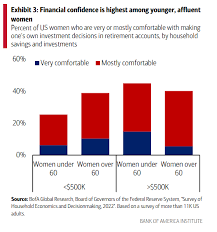
Only 28% of U.S. women are very or mostly comfortable making investment decisions vs. 39% of men, especially around retirement. Women also tend to be more risk-averse than men, allocating a smaller percentage of their investments to equities and riskier assets like cryptocurrency than men.
Even as money is spread more evenly between women and men, that money will remain concentrated in wealthy countries and among wealthy families.. Over 40 countries globally still lack gender-equal inheritance laws, and almost two-thirds of these are lower-middle and lower-income countries.
The top 1 percent of earners receive inheritances at twice the rate of those in the bottom 50 percent of earners. Among those who inherited, the average inheritance of those in the top 1 percent is 11x higher than the average inheritance of those in the bottom 50 percent. All told, close to half (41%) of reported inheritances (by value) went to the top 10 percent of earners.
This interview has been edited for length and clarity.
Welcome to another episode of “The Impact” on FinTech TV. I spoke to Adam Rein, who is the CEO and co-founder of CapShift, an investing platform that helps private wealth and charitable asset owners more easily build impact investment portfolios. One of the things that I’ve been focused on for the last decade is how to get donor-advised fund money flowing into impact investing.
Jeff Gitterman: We’re going to talk a lot about different things, but let’s start off with why did you start CapShift?
Adam Rein: Why did we start CapShift? It’s hard to build impact investment portfolios. When you look out at the market and ask investors ‘are you interested in impact investing?’ about half of them say ‘I’m interested.’ When you ask ‘have you made an impact investment?’ the majority who are interested haven’t made an impact investment yet. Why? It’s a complicated part of the investments market. It is generally focused on alternative investments, thematic investments.
And so at CapShift we’ve built a software enabled platform that helps the intermediaries that manage private wealth, family offices, wealth advisors or charitable asset owners, like donor-advised funds or private foundations, more easily build portfolios tailored to these themes that families care about, like climate solutions, affordable housing, access to health care, microfinance. We started five years ago and we’re excited to keep scaling up the platform.
JG: So one of the biggest challenges for firms that don’t have a big due diligence shop behind them is how do they due diligence these products and find a level of comfort putting their client’s money into this? How have you solved that challenge?
Adam Rein
AR: We rolled out a research engine last year that covers over 900 different impact investment funds and investment opportunities. And we not only do the hard work of sourcing across the market, many of these are proprietary deals that are not easy to find and access. But we have a dedicated due diligence team that covers financial diligence, operational diligence and, uniquely, impact diligence.
And you may be aware that there’s a lot of talk about greenwashing the market, a lot of reputational risk. And we’ve built upon many of the leading methodologies about how do you look at impact management across a fund manager, or impact outcomes, impact risks, and really standardize that rating methodology for the funds we look at.
JG: So are there categories when someone comes to CapShift where they can literally come to the website and say, ‘I have a client really interested in climate tech,’ as you mentioned, ‘and just look who are the 10 firms that might meet that criteria?’
AR: Firms that subscribe to our platform to access our research engine can search like you may with other investment platforms. So you can search by asset class, by fund size, return outcomes. One interesting part around impact investing and those sorts of confusion is a question we get a lot — ‘are these investments going to generate strong returns or weaker returns?’ And the answer is both.
There’s actually two segments of impact investments. In some parts of the market, there are opportunities that are offering targeting risk-adjusted market rate returns. You see that a lot in the climate investing space. There’s other categories that we call Impact First, that are really geared for charitable assets, and are targeting an impact-first approach to the market, oftentimes looking at social equity or racial equity as a goal of these funds. And so we help investors sift through those different categories to find what’s going to be the best fit for my client.
JG: We talked about starting CapShift, but was the impetus to start CapShift because of what was going on in the charitable side of the world?
AR: The origin is our founding team had lived this problem, working in the family office and investment environment trying to do impact investing, seeing how hard it was. Our initial market was around donor-advised funds, which to some people are one of the most exciting parts of the market, and others, ‘What is a donor-advised fund?’ These are emerging vehicles that make it easier for clients to deploy charitable assets, get a tax break today, and then an efficient way to invest those assets and grant them out to nonprofits over time.
CapShift photo
And so through our platform, we started in saying, well, for many clients if they’re interested in impact investing, the natural place to start would be any charitable assets that they are stewarding. Because those are the assets that are already geared for charitable intent and mission, and the ability to not only grant it out to nonprofits but also make investments that further the purpose and mission of those clients is an exciting way to unlock the power of those assets. And so we started with a set of donor-advised fund clients and then have spread beyond to other charitable and private wealth client types.
JG: Let’s drill down into that a little bit. So basically what happens is a client makes a donation into a donor-advised fund. They get really the full write-off of that, but it’s an irrevocable donation into that fund. And then what typically happens in the current state of the world is that 5% a year of that capital gets distributed to charities that they choose each year, and maybe it’s the same one each year and they can make different choices to multiple charities.
But that corpus sits there, typically invested in just your traditional 60/40 portfolio. So the client already has an intent to want to do impact, but the bulk of the capital is sitting there doing nothing for impact, and that is really the solution that you guys are coming in and addressing right at the core. What is the amount of assets that sit in these vehicles, unfortunately not doing impact right now?
AR: Donor-advised funds alone are a little over $200 billion of assets. If you add in private foundations, the charitable investment market is about $1.5 trillion in assets. It’s a very underserved part of the wealth market. By our estimate, if you take out the more generic ESG funds in public markets and just look at impact funds, mostly in private markets, less than 1% of charitable assets across the whole market is invested in an impact-oriented investment.
We believe there’s a potential to scale that up 10x or more. And really it’s geared toward not only helping unlock capital to make the social-environmental change in the world that’s needed, but really from the firms that are stewarding this money, it’s about helping make their clients happy, because more and more millennials, wealth creators and others are saying this is just a better way to do kind of 21st century model of philanthropy.
JG: And also there’s this term Death Valley, where a lot of these small venture funds that are sub $25 million raises cannot raise any money. Especially with the collapse of SVB Bank, it has made it incredibly difficult across the spectrum to find early funding on early venture, let alone in impact, but really across the board right now. And this really pocket or pool of money, this 200 plus billion dollars in DAF seems like the most obvious place to tap into for that Death Valley space that exists out there.
AR: I think there’s just a lot of excitement because many of the problems that people care about are too large to tackle just with small grants and nonprofits. Obviously climate change is the one top of mind, but if you think about the obesity epidemic, if you think about social justice issues and the collapse of urban cities, if you think about sustainable food systems, these are all problems that need tens, hundreds of billions of dollars of capital to flow in.
JG: I’m curious, because you’re a platform, what are the range of minimum investment requirements for an end client of an advisory firm? Or are some advisory firms doing some kind of wrapper programs like SBV’s to be able to get into the minimums of some of the underlying investment companies?
AR: Our starting point is working with families who are going to deploy $500,000 or a million plus accounts into impact portfolios. Some of the underlying investments could be minimums as low as $100,000, or in some interesting vehicles like recoverable grants and nonprofits as low as $25,000.
JG: So let’s touch on what you spoke about much earlier, this kind of conflict around how impact measurement is being done or ESG is being done. When you talk to advisers today, what are you hearing? Do they understand the difference between impact and maybe ESG? Are they gravitating more towards impact because it is maybe more measurable and more thematic to a client’s interest than just the broader based ESG definition in general?
AR: There’s still a lot of confusion in the market. Some people say the words impact investing, and they use that to cover a lot of ESG funds and public market investing. Others use it to talk almost only about private markets investing. That’s more of how we use it. Authentic impact is very core to what we do.
I think ESG funds have been very popular because they replicate a lot of the risk/return profile of traditional public markets funds. You have large baskets of public companies in the funds, but there’s been confusion as ESG was originally around a risk management tool, looking at environmental social government risk as risk assessment tools.
But a lot of the critique of ESG has said, these are no longer risk assessment tools. There is the ideological tools and the public markets. I think a lot of that controversy is focused on public, institutional investors, a little less important to our world, which focuses on private wealth and charitable assets. There, I think, ESG is interesting, but oftentimes clients say, ‘How has this ESG fund actually changed the world after I allocated capital when it’s spread among hundreds of public companies?’ And it’s hard for fund managers to answer that.
CapShift photo
I think with the impact funds we work with, the story to the client is much, much clearer. You are helping increase access to capital for minority-led businesses in low-income communities. You are helping fuel the next generation education technologies that are going to make it easier for low-income students to get a great education.
Another interesting area we see a lot of client interested in, that surprised me, regenerative agriculture. This is the principle that our food system is unsustainable, and we should think about farm practices that are enhancing carbon sequestration in the soils, creating biodiversity on farms. I think a lot of people get excited, particularly around the idea of food and agriculture investing, because we all connect so deeply to the food we eat, and we know how tied it is into poverty, pollution, climate change and many of these other issues families care about.
JG: It’s the one political kind of bridge when you get into really conservation and regenerative ag. That’s the one place where you can have really good dialogue across party about bills and other things to support those areas. So it is, I think, an area that’s becoming at least more interesting, especially from a political landscape. And then ultimately that helps the investment landscape.
So I want to wrap up here, but we covered a lot from the investor standpoint. How do founders that are trying to raise money get in touch with you or find you guys? Is there a way to apply to get on the platform? What does that process look like?
AR: Our platform is majority allocating to fund managers. As I said, we cover over 900 private investments. Almost all of those are funds. We have our own network to source those funds, but there is a portal on capshift.com, for fund managers to share their information directly with our team. And we believe strongly in the network power that when it comes to impact investing, the more that people talk to their wealth advisers or their family office staff and share they’re interested in, it creates an effect that people start to pay attention that this is a growth area of demand.
And I think the statistic that always jumped out to me is that millennials are almost twice as likely to ask about their wealth provider, about impact investing, than the older generation. There’s a lot of focus on the wealth transfer to that next generation. And impact investing is only set to grow, and we want to help the wealth management industry be prepared.
Access to safe water and sanitation is a fundamental human right under binding international law. Yet today, a global water crisis still persists. 2.2 billion people—or 1 in 4—still lack access to safe water and 3.5 billion people—or 2 in 5—lack access to safely managed sanitation.
While gains have been made over several decades, the effects of climate change have become a large and looming factor, halting progress made. Though the role of the public sector remains paramount in addressing the crisis, private impact investment has recently also emerged as a powerful tool.
Investing in household water and sanitation solutions
Impact investing focuses on generating positive social and environmental impact while seeking financial returns. In the realm of water and sanitation, investment plays a pivotal role in supporting innovative solutions, especially at the household level. Among low-income consumers, at least 600 million people could access water and sanitation products, services and upgrades if financing was available, equating to what WaterEquity estimates as $35 billion of market demand over the next decade.
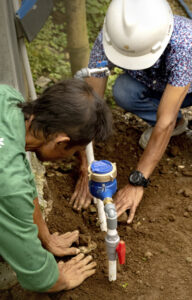
WaterEquity has approached this market opportunity through an investment strategy focused on providing debt capital to financial institutions in emerging markets to expand water and sanitation lending. These financial institutions use this capital to grow their water and sanitation microloan portfolios, as well as to on-lend to local enterprises delivering water and sanitation innovations, products and services.
Since our start in 2016, WaterEquity has deployed more than $360 million in capital to this strategy across four private investment funds, reaching more than 5 million people with increased access to safe water and sanitation.
Over 93 percent of the low-income end-clients taking out these microloans are women. This is no accident, as the funds have specifically targeted women beneficiaries by integrating gender into our investment and decision-making processes. And the microloans are repaid at the average rate of 97-99% within 12-24 months. Ensuring equitable access to safe water and sanitation cannot be accomplished without giving women the power and the capital to solve for their futures.
Photo courtesy of WaterEquity/water.org
Investing in climate-resilient infrastructure
Financing the “last mile” of water and sanitation access at the household level will only take us so far in reaching the billions affected. There is also a tremendous need and market opportunity for sustained investment in potable and wastewater infrastructure seeking to increase access to water and sanitation services, improve water quality and mitigate the impacts of water scarcity.
Moreover, with traditional infrastructure often vulnerable to damage from extreme weather events, investment in resilient systems is essential for ensuring sustainable access to water and sanitation services.
By investing in climate-resilient infrastructure, WaterEquity’s Water & Climate Resilience Fund aims to reach 15 million people with water and sanitation access, and indirectly benefit millions more through improvements in water quality and scarcity.
Investments include government tendered projects such as the construction of decentralized water treatment plants, the upgrading of existing infrastructure to withstand extreme weather events and the implementation of smart water management systems. The Fund will also invest directly in growth companies that are developing and deploying innovative technology and services within the sector. These projects and companies enhance the reliability and efficiency of water and sanitation systems at scale, while also contributing to the overall climate resilience of underserved communities.
Conclusion
Impact investing has the potential to transform the landscape of water and sanitation, addressing the complex challenges posed by the water crisis, climate change, and gender disparities. By supporting innovative household solutions and investing in climate-resilient infrastructure, impact investors can contribute to the Sustainable Development Goals and improve the well-being of communities around the world, aligning values with the potential for financial returns.
This holistic approach not only addresses immediate water and sanitation challenges but also builds resilient communities capable of withstanding the impacts of a changing climate. Through strategic and socially responsible investments, we can ensure a future where safe water and sanitation are accessible to all.
Elan Emanuel is the chief investor relations officer at WaterEquity. Elan is responsible for mobilizing investments and partnerships with a broad portfolio of investors to accelerate WaterEquity’s impact addressing the global water and sanitation crisis. WaterEquity emerged out of Water.org and was cofounded by actor Matt Damon and Gary White.
Investing beyond numbers: paving the path for a sustainable future
Gone are the days when investing was solely about maximizing profits. Today, it’s about making a meaningful impact, and therefore individual investors are increasingly seeking to align their financial goals with their personal values.
The attraction of Environmental, Social, and Governance (ESG) investing stems from two primary aspects. First, some individual investors prioritize their ethical values and social responsibility over maximizing profits. In other words, they are willing to forgo some profit to contribute to societal good. Second, profit-driven investors believe companies that focus on ESG responsibility are likely to be better managed and more adept at foreseeing and reducing risk, making them better potential long-term investment opportunities.
Struggles with Sustainability
While sustainable investing is gaining traction, many retail investors still do not consider ESG when making investment decisions. This is driven by several underlying factors, including lack of education about ESG, the appearance of limited investment options, accessibility and consistency in ESG data, and combatting short-termism, to name a few.
Lack of education
One of the most common hurdles in ESG stems from a lack of education—a lack of familiarity with and understanding of what investment options are available to them. For example, a study from owlesg.com points out that 46% of respondents stated that the main reason they don’t consider ESG investments is a lack of familiarity. This also study highlighted that nearly 28% of respondents didn’t know how to determine whether an investment was ESG-friendly, and just 15% noted performance concerns as a reason for not investing in ESG.
This study highlights that retail investors need help understanding how to learn about and research ESG investments, not necessarily performance concerns.
Limited investment options
According to a study by the Wisdom Council, nearly six in ten retail investors are unaware that they can invest in a way that positively contributes to ESG, and four out of five surveyed believe they have a key role to play in protecting the environment.
Data accessibility and consistency
Another key hurdle for individual investors is the lack of easy access to ESG data through a single source. Instead, many companies publish “sustainability reports,” requiring investors to fumble through pages of jargon, often leaving them more confused than when they started.
To further highlight this point, according to frameworkESG.com, nearly 600 different ESG ratings are published globally, making it exceedingly difficult for investors to make sense of varying guidance and frameworks.
Short-termism
Short-termism is characterized by a myopic focus on immediate financial gains at the expense of long-term sustainability and is another obstacle to sustainable investing. Many companies prioritize short-term profits to meet quarterly earnings targets, often neglecting long-term investments in sustainable practices.
Investors can advocate for corporate accountability and encourage companies to adopt a more holistic approach that considers both financial performance and environmental stewardship; however, this is more commonly done from an institutional level.
In many cases, short-termism can be difficult but possible to combat. For example, a recent Harvard Business Reviewarticle points out that when Paul Polman became the CEO of Unilever, then an underperforming consumer goods giant, he immediately ended quarterly earnings guidance. Instead, became explicit about his commitment to a long-term strategy rather than focusing on short-term profits.
That guidance led to an exodus of short-term-focused investors, thereby attracting more patient capital which is critical to sustainability efforts.
Empowering investors to make an impact
To make a difference, individual investors need to adopt a strategic approach that combines financial returns but also consider social and environmental impact.
According to a study by the Morgan Stanley Institute for Sustainable Investing and Morgan Stanley Wealth Management, approximately 77% of individual investors worldwide are “interested in investing in companies financial returns while also considering positive social and/or environmental impact.”
Studies show that investing in ESG companies does not affect returns. According to a study from Morningstar, it found no risk/reward trade-off to investing in ESG companies – in other words, retail investors do not have to compromise returns in exchange for building a portfolio of ESG companies.
So what does this all mean?
It is clear that investors are not concerned about sub-optimal returns with ESG investments and empirical data indicates the same. Instead, individual investors need to become more familiar with ESG. They don’t know how to make sense of the labyrinth of ESG rating methods, how to access and read them, and what ESG-friendly investment options are available. ESG investing has just become too complicated for many retail investors.
Join ESG communities and events
To engage with fellow ESG enthusiasts and professionals, consider joining online and offline communities and events. These platforms provide valuable opportunities for networking, learning, and collaboration. Among the most active and diverse are:
The ESG Investing Group on LinkedIn a community for ESG investors to exchange news and perspectives.
The ESG Circle on Meetup a local community where ESG enthusiasts can connect and socialize.
Familiarize yourself with ESG standards and ratings
To grasp ESG concepts, start by acquainting yourself with the various standards and ratings that assess and benchmark ESG performance across sectors, regions, and themes.
Among the most prevalent and reputable are:
The Global Reporting Initiative (GRI)
Sustainability Accounting Standards Board (SASB),
Task Force on Climate-related Financial Disclosures (TCFD),
UN Principles for Responsible Investment (PRI). These frameworks offer guidance, metrics, and leading practices for reporting and disclosing ESG data to diverse stakeholders.
Understand ESG investing approaches
Generally speaking, there are 3 common ESG investing approaches: Values-based, ESG Integration, and Impact Investing. Retail investors must know these approaches compared to traditional investing.
1. Values-based investing, or Socially Responsible Investing (SRI), is one of the most well-known ESG investing approaches. This approach involves avoiding investments in specific sectors or companies, like tobacco, firearms, or fossil fuels – colloquially known as ‘sin stocks.’ This strategy appeals to retail investors who want to avoid supporting businesses they may find objectionable.
Investors can easily get exposure to funds that avoid ‘sin stocks.’ For example, VFTAX, Vanguard FTSE Social Index Fund, is a mutual fund screened for specific environmental, social, and corporate governance (ESG) criteria.
2. ESG integration is a more contemporary investment strategy pioneered by major investors like pension funds and endowments, but it can also be applied by individual investors. ESG integration strategies are usually more aligned with broad benchmarks, offering some exposure to economic sectors rather than entirely excluding specific sectors they may deem unacceptable. Put simply, these strategies do not avoid specific industries entirely; rather, they limit their investment exposure.
For investors just getting started in ESG investing, an ESG Integration approach may be the most practical to implement.
3. Impact investing is a more direct approach that involves investing money to achieve a specific positive outcome. Examples include offering loans to low-income homebuyers, funding projects to cut factory air pollution, investing in carbon credits, or even buying shares in a company to influence its policies.
While it may be difficult for individual investors to provide funding or influence a company’s policy directly, one example is Vanguard’s Bailie Gifford Global Positive Impact Stock Fund Investor Shares, VBPIX, which is an “actively managed fund that seeks to invest in global high-quality growth companies that can deliver positive change in one of four areas: Social Inclusion and Education, Environment and Resource Needs, Healthcare and Quality of Life, and addressing the needs of the world’s poorest populations.”
Bringing it all together
Empowering every investor to embrace sustainable investing requires addressing challenges related to transparency, data quality, regulatory compliance, and short-termism. By fostering a culture of accountability, promoting education, and providing accessible investment options, we can bridge the gap between values and finance, paving the way for a more sustainable future.
The Sustainable Finance Podcast is a weekly program featuring conversations with sustainability thought leaders such as cleantech entrepreneurs, VC investors, CEOs, NGO executives, and creators of the ESG indices and analytics platforms.
Radhika Shroff is managing director, impact investing/private equity at Nuveen, one of the world’s largest institutional investors. For Radhika and her Nuveen private equity team, their investment thesis is rooted in addressing two critical and inextricably linked problems: inequality and climate change.
With impact investing at an inflection point in 2024, I asked Radhika to explain how tackling these two issues creates attractive impact investment opportunities outside of traditional developed markets while offering investors stable, competitive returns — a process that also identifies companies best positioned to grow and lead in the decades to come.
Paul Ellis: Radhika, in the current market, what are some of the key trends in impact investing that you and your team are paying attention to in 2024?
Radhika Shroff: I have some key trends in mind, and as I thought about them, I hope they are not wishful thinking but are actual trends. We are focused on investing in growth stage businesses that are either solving a climate issue or an inequality issue.
The reason we’re focused on those two sectors is because we do believe that they’re inextricably linked, and that as the world warms, different populations are going to be impacted in different ways. So, for example, me living in an apartment building in New York City, I’m going be impacted very differently from climate change than a small holder farmer living on the coast of India. I’m also going be impacted very differently than somebody living in affordable housing also in New York City.
So we’re really focused on that confluence and saying it’s not just that we need to think about how to get more carbon dioxide out of the air. We do need to do that, but we also need to focus on ensuring that populations, wherever they are in the world, are resilient to climate change. And we believe that inequality plays a big factor in that.
The first broad macro trend that we’re seeing is that asset allocators are starting to see impact private equity as a mainstream asset class. And importantly, I think they’re also starting to see that you can invest with an impact fund and still expect the same returns that you expect from all of your mainstream private equity funds.
And not only can you expect them, you should expect them. The thesis behind this is that we’re not going to solve the world’s biggest problems without being able to attract commercial capital. And the only way we can attract commercial capital is by showing commercial capital that we can return private equity returns with our impact investments. And that impact and financial return are not mutually exclusive. They can actually go hand to hand.
We’re seeing through our efforts, our fundraising efforts, etc., and increasing recognition, that a fund like ours should be put on the same level as any other private-equity fund out there that might be looked at in terms of returns.
PE: I think those are very important points to make right up front because as you say, a lot of investors over the last 50 years or so have shied away from the private markets in terms of impact investing for a number of reasons. But what unique benefits can impact investing offer from both a financial and environmental and social impact perspective?
Radhika Shroff
RS: Private equity is really the tip of the spear when it comes to driving impact in companies. So, as we know, private equity is longer term than public markets, and we have a five to seven year investment horizon. And so we’re able to sit at the table for at least five years working hand in hand with the company, the management team, the other shareholders, and we’re typically minority shareholders, to say not only how can we drive financial performance, but how can we also drive impact?
One example: We recently invested in a company called Power Takeoff, a company that drives energy efficiency in the small business sector, and its clients are utilities. The small business sector of the United States is typically underserved when it comes to energy efficiency solutions. And so we were super interested in that piece of it. As I’ve noted, we not only like to provide our capital, we like to provide engagement as well to help companies meet their goals.
With Power Takeoff what we’re doing is we’re leveraging the know how of our broader real estate platform, in particular, our affordable housing platform, which is the largest in the United States, and saying: How can we help this company increase its revenue, not only by targeting just small businesses, but also by targeting small business energy efficiency in low-income communities?
Right there you see an example of private equity being particularly impactful when it comes to driving both revenue as well as impact. And you also see coming to fruition our thesis that we want to make sure that low-income communities are not left out of the climate transition.
PE: So this is an example of a dual purpose focused on a particular investment idea and a company that offers these kinds of services. And you can apply it, as you’re saying, across a broad population of opportunity because of your engagement with the sector of the economy that it’s based in.
RS: Yes. What we’re saying is as private equity investors we can be patient, right? We do need to exit, but we can be more patient. And we can engage in such a way that drives impact. And if the impact is linked to the core revenue model of the business, as we drive more impact, we’re also driving more revenue. And that is really our goal as private equity investors.
PE: How do you and your team evaluate the investments that you’re in? There’s clearly a very-well-thought out process.
RS: I noted that we have a very well-thought-out impact thesis. We invest in either climate solutions or income inequality, and we love it when the two come together, when we invest in a business where we can help drive that equitable transition. But we’re like any other private equity fund. We look at the growth dynamics of the business.
We look at profit, profitability, we look at margins. We look at the segment, competition, we look at management teams. We look at the risk of the countries that we’re looking at. We look at competition and, importantly, we care deeply about exit optionality. We know being private equity and impact investors for over a decade that our industry needs to show investors that companies can be exited, and they can be exited in the same way, with the same velocity as a non-impact focused company. And so we’re really focused on exit.
I would say the way we look at our companies is the same way as anybody else, but we go a step further because we’re impact investors. We say, what is the “but for” of this company, if this company did not exist, what are the other options that the end consumer or the end segment has to solve this issue for themselves in a commercial way?
And this “but for” conversation is key and happens to be one of the most lively conversations we have on the team when we’re thinking about an investment because every single person on our team wants to be intellectually honest around the fact that this is a company, as it grows, it’s actually increasing its positive impact on the world more than not.
Rajani Srichandana, a client of Annapurna Finance.
One example: We invested in an Indian microfinance institution called Annapurna Microfinance. Now, this is a company that served around 1.5 million female entrepreneurs with working capital loans so they could grow their business when we first considered investing. And we said, okay, “but for” our investment, what would actually happen here? Where else could these people go?
This is a company that happens to be going to some of the hardest to reach places serving women who are underserved from a working capital standpoint with well-priced loans. Since we’ve invested, this company has doubled in size and we are likely going to be able to exit in the next 12 to 18 months at really strong returns. And we’re saying, look, we invested, it’s doubled in size, and therefore it now serves 2.5 million women with working capital—not loans. And that’s where we see our investment going hand in hand with the impact that we’re trying to drive.
PE: That’s very impressive data. Can you give us the timeframe in which this has happened?
RS: We’re really proud of it. We invest globally, largely in the United States and India, and some of us on the team have been in investing in India for over a decade and driving the same level of returns that you would see in the United States on U.S. dollar terms. In Annapurna, we made the investment in March 2021. It was a really difficult time to be making investments in India. That was right before wave two of Covid.
But because we know the sector so well, and because we know the management team so well and the business model, we knew that if we made the investment at this moment in time, we would be strengthening the company’s balance sheet at a very, very good valuation. And we knew that those dollars would go towards making more loans to underserved communities. The company grew from 1.8 million clients to 2.5 million clients in the last three years.
PE: So is this part of your methodology that you and your team use in scrutinizing every type of investment that you’re looking at in these markets?
RS: Yes. We really like when we’re serving low-income, underserved clients, especially on the financial inclusion piece, which is largely in an emerging markets India play, but we also care deeply about climate. So again, for example, In India we invested in a company called Ecozen, a company that manufactures and markets IOT enabled solar irrigation pumps and cold storage, largely for small holder farmers who are living in areas that could be off the grid or have unreliable utility service. And this helps them keep their crops irrigated and store their crops for longer periods of time in order to increase their income.
Ecozen photo
And in that one investment, what we’ve done is invest in a climate mitigation, a carbon dioxide reducing product. In fact, that one company in one year alone, reduces carbon dioxide emissions by 500,000 tons a year. And we’re helping small holder farmers with the reliability of being able to grow and store their crops. So it is really emblematic of what we’re doing.
And by the way, all of these companies in our Fund One, they’re on average growing at 40% to 50% a year. What that really means to us is that we’re investing in commercially viable, profitable companies with strong profit margins that are serving an underserved segment of the community that really needs these basic services. And that’s really the sweet spot of what we’re doing.
PE: How do these underserved communities in these economies around the world react to a company like Nuveen coming into their community and offering this type of capital infusion and long-term investment strategy? That must be an extraordinary process and if you could just share with us some of the reactions that you get from the local people, that would be very helpful.
RS: Sure, absolutely. We have a really lovely video of clients in Annapurnatalking about what Nuveen has done for their lives. But I’ll tell you, we’ve been investing in these emerging economies for over a decade. We’re pretty well known. When we come to the table and say we want to look at this business, people are excited and happy. Because they know a couple things.
One is that we are intellectually honest around caring about impact. And so that gives management comfort that we’re not going to be there just driving profitability for profitability’s sake. We want to make sure that profitability is coming in lockstep with the impact. And so it gives them some sense, OK, it’s this big U.S. firm, who are they going to be? What are they going to be like? They know from our reputation that we are going to be there to support them on the impact side as well.
The second thing, they know we can really help them scale. We typically come in, we’re not venture investors, but we’re also not TPG Rise. We are there to help them with what we call the missing middle: we believe there’s a lack of commercial investors in that stage of the company development from when it’s proven the commercial viability of its product or service to what is completely scaled to be able to exit to the public markets. Or to be able to do a strategic sale or sell to a TPG Rise for example.
And they know that we’ll be there, and we know how to help them scale. I think we see that our pipeline outside the United States is just as exciting as our pipeline inside the United States and that’s why we’re building a balanced portfolio.
PE: That’s terrific news. A lot of people in the private markets in developed economies look at the potential risks of these types of investments and shy away from them. What you’re saying is that you have dug much deeper into the process of these economies and the people that you’re working with and come up with ideas that are leveraging opportunities in those economies and at the same time de-risking the longer term investment strategy. Am I on the mark?
RS: Absolutely. And it takes a great deal of experience to be able to do that. Like it’s pattern recognition. It’s the people you know understanding, you know you can’t predict, but you can understand how currencies move, the macro environment, we’ve done all that. We’ve been doing it for over a decade.
And as I said, and I can’t say this enough, the things that we see in India, in particular the growth that we’re able to see there, the returns we’re able to drive are on par, if not better, than some of the developed economies we look at.
PE: Are there other developing economies around the world that Nuveen is looking at or already engaged with that you can share with us?
RS: We look at all of the largest economies. So, some of the larger countries in Southeast Asia and Latin America. We actually have an investment in a payments company in Latin America that essentially provides mom and pop shops in rural areas in Peru with a handheld device so they can turn into mini bank branches.
So this is really financial inclusion. You are going into the Andes Mountains. You’re handing a store owner a handheld device and a customer that lives in that neighborhood doesn’t have to travel 3 hours to the nearest bank branch.They can do simple financial transactions at this mom and pop shop in their neighborhood.
And this mom and pop shop, which is owned often by a female entrepreneur, is able to increase the revenue of her shop by 20% to 30%. And these investments outside the United States are made after deep (review); I had known this company for 10 years before I made the investment.
Financial inclusion is something we know really well. So we don’t take it lightly. We know that investing outside the United States has its macro risks. But I think if you have the right team that has done it for a long time and knows how to underwrite for those risks to the extent possible, you can end up with really good, strong risk adjusted returns.
PE: Radhika, where can people go to learn more about private equity impact investing at Nuveen?
RS: You can find us on the new Nuveen website. We have some really interesting thought leadership pieces there, where we talk about why we invest in India, why we invest in companies that are focused on decarbonization of buildings. And anyone can find me on LinkedIn.