This interview has been edited for length and clarity.
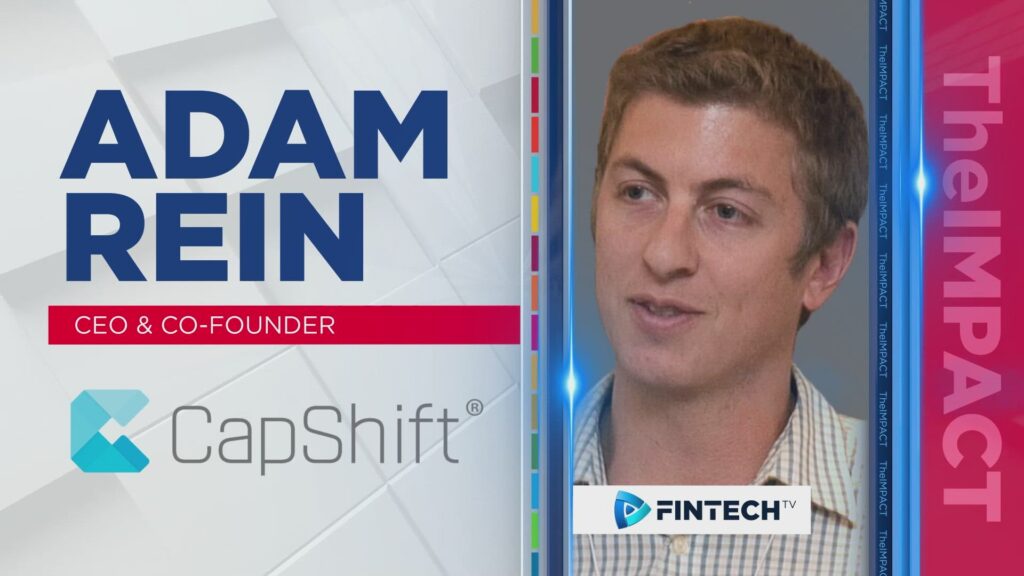
Welcome to another episode of “The Impact” on FinTech TV. I spoke to Adam Rein, who is the CEO and co-founder of CapShift, an investing platform that helps private wealth and charitable asset owners more easily build impact investment portfolios. One of the things that I’ve been focused on for the last decade is how to get donor-advised fund money flowing into impact investing.
Jeff Gitterman: We’re going to talk a lot about different things, but let’s start off with why did you start CapShift?
Adam Rein: Why did we start CapShift? It’s hard to build impact investment portfolios. When you look out at the market and ask investors ‘are you interested in impact investing?’ about half of them say ‘I’m interested.’ When you ask ‘have you made an impact investment?’ the majority who are interested haven’t made an impact investment yet. Why? It’s a complicated part of the investments market. It is generally focused on alternative investments, thematic investments.
And so at CapShift we’ve built a software enabled platform that helps the intermediaries that manage private wealth, family offices, wealth advisors or charitable asset owners, like donor-advised funds or private foundations, more easily build portfolios tailored to these themes that families care about, like climate solutions, affordable housing, access to health care, microfinance. We started five years ago and we’re excited to keep scaling up the platform.
JG: So one of the biggest challenges for firms that don’t have a big due diligence shop behind them is how do they due diligence these products and find a level of comfort putting their client’s money into this? How have you solved that challenge?
AR: We rolled out a research engine last year that covers over 900 different impact investment funds and investment opportunities. And we not only do the hard work of sourcing across the market, many of these are proprietary deals that are not easy to find and access. But we have a dedicated due diligence team that covers financial diligence, operational diligence and, uniquely, impact diligence.
And you may be aware that there’s a lot of talk about greenwashing the market, a lot of reputational risk. And we’ve built upon many of the leading methodologies about how do you look at impact management across a fund manager, or impact outcomes, impact risks, and really standardize that rating methodology for the funds we look at.
JG: So are there categories when someone comes to CapShift where they can literally come to the website and say, ‘I have a client really interested in climate tech,’ as you mentioned, ‘and just look who are the 10 firms that might meet that criteria?’
AR: Firms that subscribe to our platform to access our research engine can search like you may with other investment platforms. So you can search by asset class, by fund size, return outcomes. One interesting part around impact investing and those sorts of confusion is a question we get a lot — ‘are these investments going to generate strong returns or weaker returns?’ And the answer is both.
There’s actually two segments of impact investments. In some parts of the market, there are opportunities that are offering targeting risk-adjusted market rate returns. You see that a lot in the climate investing space. There’s other categories that we call Impact First, that are really geared for charitable assets, and are targeting an impact-first approach to the market, oftentimes looking at social equity or racial equity as a goal of these funds. And so we help investors sift through those different categories to find what’s going to be the best fit for my client.
JG: We talked about starting CapShift, but was the impetus to start CapShift because of what was going on in the charitable side of the world?
AR: The origin is our founding team had lived this problem, working in the family office and investment environment trying to do impact investing, seeing how hard it was. Our initial market was around donor-advised funds, which to some people are one of the most exciting parts of the market, and others, ‘What is a donor-advised fund?’ These are emerging vehicles that make it easier for clients to deploy charitable assets, get a tax break today, and then an efficient way to invest those assets and grant them out to nonprofits over time.

And so through our platform, we started in saying, well, for many clients if they’re interested in impact investing, the natural place to start would be any charitable assets that they are stewarding. Because those are the assets that are already geared for charitable intent and mission, and the ability to not only grant it out to nonprofits but also make investments that further the purpose and mission of those clients is an exciting way to unlock the power of those assets. And so we started with a set of donor-advised fund clients and then have spread beyond to other charitable and private wealth client types.
JG: Let’s drill down into that a little bit. So basically what happens is a client makes a donation into a donor-advised fund. They get really the full write-off of that, but it’s an irrevocable donation into that fund. And then what typically happens in the current state of the world is that 5% a year of that capital gets distributed to charities that they choose each year, and maybe it’s the same one each year and they can make different choices to multiple charities.
But that corpus sits there, typically invested in just your traditional 60/40 portfolio. So the client already has an intent to want to do impact, but the bulk of the capital is sitting there doing nothing for impact, and that is really the solution that you guys are coming in and addressing right at the core. What is the amount of assets that sit in these vehicles, unfortunately not doing impact right now?
AR: Donor-advised funds alone are a little over $200 billion of assets. If you add in private foundations, the charitable investment market is about $1.5 trillion in assets. It’s a very underserved part of the wealth market. By our estimate, if you take out the more generic ESG funds in public markets and just look at impact funds, mostly in private markets, less than 1% of charitable assets across the whole market is invested in an impact-oriented investment.
We believe there’s a potential to scale that up 10x or more. And really it’s geared toward not only helping unlock capital to make the social-environmental change in the world that’s needed, but really from the firms that are stewarding this money, it’s about helping make their clients happy, because more and more millennials, wealth creators and others are saying this is just a better way to do kind of 21st century model of philanthropy.
JG: And also there’s this term Death Valley, where a lot of these small venture funds that are sub $25 million raises cannot raise any money. Especially with the collapse of SVB Bank, it has made it incredibly difficult across the spectrum to find early funding on early venture, let alone in impact, but really across the board right now. And this really pocket or pool of money, this 200 plus billion dollars in DAF seems like the most obvious place to tap into for that Death Valley space that exists out there.
AR: I think there’s just a lot of excitement because many of the problems that people care about are too large to tackle just with small grants and nonprofits. Obviously climate change is the one top of mind, but if you think about the obesity epidemic, if you think about social justice issues and the collapse of urban cities, if you think about sustainable food systems, these are all problems that need tens, hundreds of billions of dollars of capital to flow in.
JG: I’m curious, because you’re a platform, what are the range of minimum investment requirements for an end client of an advisory firm? Or are some advisory firms doing some kind of wrapper programs like SBV’s to be able to get into the minimums of some of the underlying investment companies?
AR: Our starting point is working with families who are going to deploy $500,000 or a million plus accounts into impact portfolios. Some of the underlying investments could be minimums as low as $100,000, or in some interesting vehicles like recoverable grants and nonprofits as low as $25,000.
JG: So let’s touch on what you spoke about much earlier, this kind of conflict around how impact measurement is being done or ESG is being done. When you talk to advisers today, what are you hearing? Do they understand the difference between impact and maybe ESG? Are they gravitating more towards impact because it is maybe more measurable and more thematic to a client’s interest than just the broader based ESG definition in general?
AR: There’s still a lot of confusion in the market. Some people say the words impact investing, and they use that to cover a lot of ESG funds and public market investing. Others use it to talk almost only about private markets investing. That’s more of how we use it. Authentic impact is very core to what we do.
I think ESG funds have been very popular because they replicate a lot of the risk/return profile of traditional public markets funds. You have large baskets of public companies in the funds, but there’s been confusion as ESG was originally around a risk management tool, looking at environmental social government risk as risk assessment tools.
But a lot of the critique of ESG has said, these are no longer risk assessment tools. There is the ideological tools and the public markets. I think a lot of that controversy is focused on public, institutional investors, a little less important to our world, which focuses on private wealth and charitable assets. There, I think, ESG is interesting, but oftentimes clients say, ‘How has this ESG fund actually changed the world after I allocated capital when it’s spread among hundreds of public companies?’ And it’s hard for fund managers to answer that.

I think with the impact funds we work with, the story to the client is much, much clearer. You are helping increase access to capital for minority-led businesses in low-income communities. You are helping fuel the next generation education technologies that are going to make it easier for low-income students to get a great education.
Another interesting area we see a lot of client interested in, that surprised me, regenerative agriculture. This is the principle that our food system is unsustainable, and we should think about farm practices that are enhancing carbon sequestration in the soils, creating biodiversity on farms. I think a lot of people get excited, particularly around the idea of food and agriculture investing, because we all connect so deeply to the food we eat, and we know how tied it is into poverty, pollution, climate change and many of these other issues families care about.
JG: It’s the one political kind of bridge when you get into really conservation and regenerative ag. That’s the one place where you can have really good dialogue across party about bills and other things to support those areas. So it is, I think, an area that’s becoming at least more interesting, especially from a political landscape. And then ultimately that helps the investment landscape.
So I want to wrap up here, but we covered a lot from the investor standpoint. How do founders that are trying to raise money get in touch with you or find you guys? Is there a way to apply to get on the platform? What does that process look like?
AR: Our platform is majority allocating to fund managers. As I said, we cover over 900 private investments. Almost all of those are funds. We have our own network to source those funds, but there is a portal on capshift.com, for fund managers to share their information directly with our team. And we believe strongly in the network power that when it comes to impact investing, the more that people talk to their wealth advisers or their family office staff and share they’re interested in, it creates an effect that people start to pay attention that this is a growth area of demand.
And I think the statistic that always jumped out to me is that millennials are almost twice as likely to ask about their wealth provider, about impact investing, than the older generation. There’s a lot of focus on the wealth transfer to that next generation. And impact investing is only set to grow, and we want to help the wealth management industry be prepared.
More from The Impact: ESG and AI tackle climate change